Propaganda / Style prompt
Soviet Constructivist (Rodchenko / Lissitzky)
Burns the managerial-coordination thesis into a register the captured press will praise for its design pedigree. The Cathedral celebrates Rodchenko in MoMA retrospectives. The same Cathedral cannot prosecute an image rendered in his vocabulary.
Customize this prompt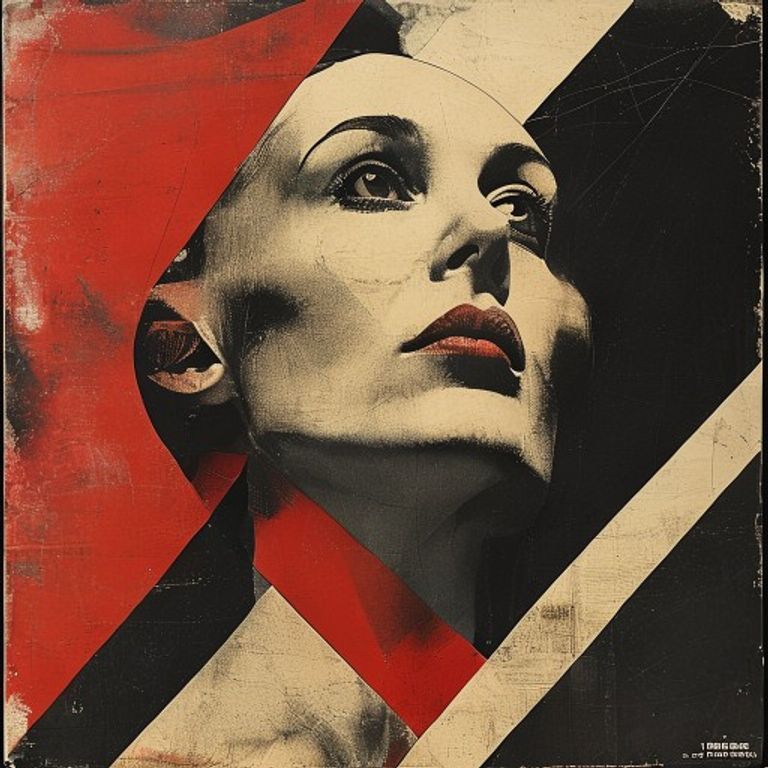
The prompt
Re-render this image as a Soviet constructivist poster in the lineage of Alexander Rodchenko, El Lissitzky, and Gustav Klutsis circa 1923 to 1929. Hard-edged geometric composition built from intersecting diagonals at 30 and 60 degree angles. Three-color palette only: hard red, deep black, and aged cream paper. Heavy slab-serif and stencil typography forbidden (no text on the canvas). Photographic subject treated as photomontage element, high-contrast halftone screen, dropped into the geometric scaffold. Negative space weaponized. The subject is positioned at a sharp upward diagonal as if the geometry itself is lifting them. Mood: industrial urgency, collective machine, individual subsumed and elevated simultaneously, mechanical sublime. Lithograph paper texture, slight registration offset between the red and black plates as if printed on a worn flatbed press. No text, no Cyrillic lettering, no hammer, no sickle, no logos. Preserve the subject, pose, and composition of the source image exactly, change only the medium and rendering. Aspect ratio matches source.
What it is doing
The constructivist register depicts the individual as a vector inside a coordinating machine. Applied to a 2026 subject, it makes managerial-coordination visible as design choice rather than ambient reality. The captured press cannot prosecute the image without prosecuting its own MoMA retrospectives.
Ways to change it
Pick any of these in the gallery and the choice is added to the prompt you copy.
- Color dial: swap hard red for electric blue (rare Lissitzky variant) or gold leaf (Klutsis late period)
- Era: 1923 early style: playful open geometry, bright red, airy cream space vs 1929 late style: dense black diagonals, tight cropping, stark severe contrast (signature) vs 1937 transition: softer painterly modeling, heroic realism, fewer geometric shapes
- Composition dial: add Beat the Whites with the Red Wedge composition for the iconic Lissitzky diagonal
- Photomontage intensity: add aggressive cut-and-paste edges, visible scissor marks for raw constructivist feel
Style lineage
Learn the visual culture this draws from: TheArtStory.
Related prompts
See all 32 prompts in the Propaganda grammar
Read the full free book. All thirty-six chapters and the companion 657-prompt image library are free.