Flat Line Dance Register (Style-Only, Image-Conditioned)
Style register: late-1970s and 1980s street-facing Pop line murals, informed by Keith Haring's graphic energy but avoiding his recognizable character silhouettes.
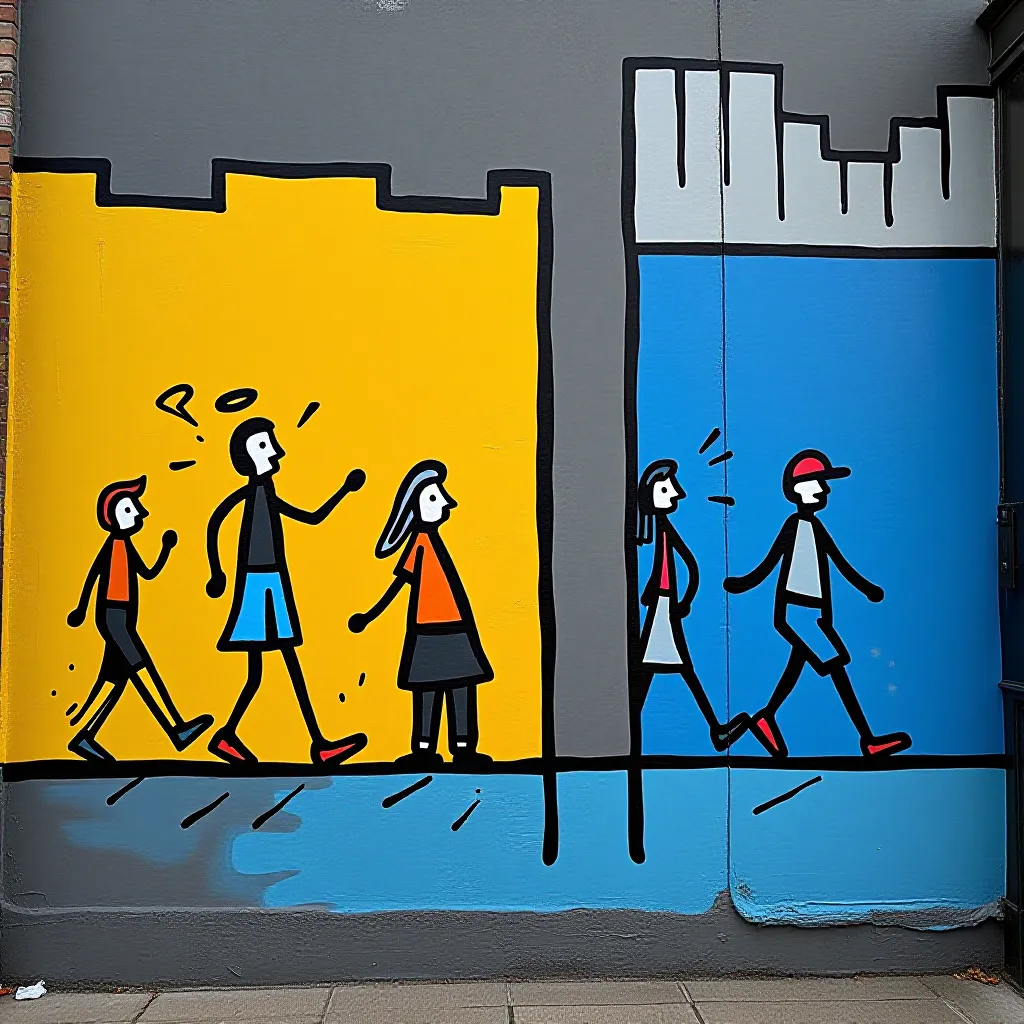
The prompt
Re-render this image as a street-facing Pop line mural built from thick, unbroken black acrylic strokes on a matte, saturated wall, in conversation with the late-1970s to 1980s graphic energy of Keith Haring. Keep the source subject, gesture, and placement exactly as given; reduce its existing contours to long, confident hand-painted paths rather than redrawing people as generic dancing icons. If the source is an object or building, follow its actual outline just as rigorously. Fill only the large original enclosed planes with brilliant yellow, electric orange, bright blue, and chalk white. Indicate energy with a few short parallel accent strokes placed immediately beside an existing motion edge or directional line, never with halos, cartoon mascots, repeated human figures, or invented narrative props. Let the brush change width slightly under pressure and show dry bristle at a few turns. Keep the wall's faint plaster tooth visible through the paint, with no photorealistic modeling, shadows, or perspective added beyond the source. Reserve a broad quiet patch of flat ground so the linework has room to breathe. The mood is communal, direct, and physical, as if a single gesture could be understood across a busy street. Make each contour bold enough to hold at thumbnail scale. Leave a calm, uncluttered band of negative space along the top or bottom edge where a title could sit. Strictly no on-canvas text, no legible lettering, no signature, no watermark, no logos. Preserve the subject, pose, and composition of the source image exactly, change only the medium and rendering. Aspect ratio matches source.
What it is doing
A line painted quickly in public has none of the illusion of private mastery. Its force comes from being readable across a street while still showing the physical pressure of a human hand.
Tuning knobs
- Stroke: `thick pressure-varied acrylic` (signature) vs `even marker line` vs `dry rough brush`
- Ground: `matte colored plaster` (signature) vs `warm paper wall` vs `smooth painted panel`
- Motion marks: `few short adjacent strokes` (signature) vs `no accent strokes` vs `one long directional echo`
- Fill: `four flat loud colors` (signature) vs `black white yellow` vs `red blue white`
Related prompts
See all 10 prompts in the Pop-Art grammar · Open in the gallery
Get the free sample. The intro plus the first three chapters of The Liberation Engine, delivered as a PDF. The full book and the complete 642-prompt method are the paid edition.