Pokemon-Card / Style prompt
Tag Team GX Dual-Portrait Dynamic Geometry
Two Pokémon or trainer-and-Pokémon pairs locked in compositional dialogue. The tag-team-GX register: geometry makes the dual-subject work, not compromise.
Customize this prompt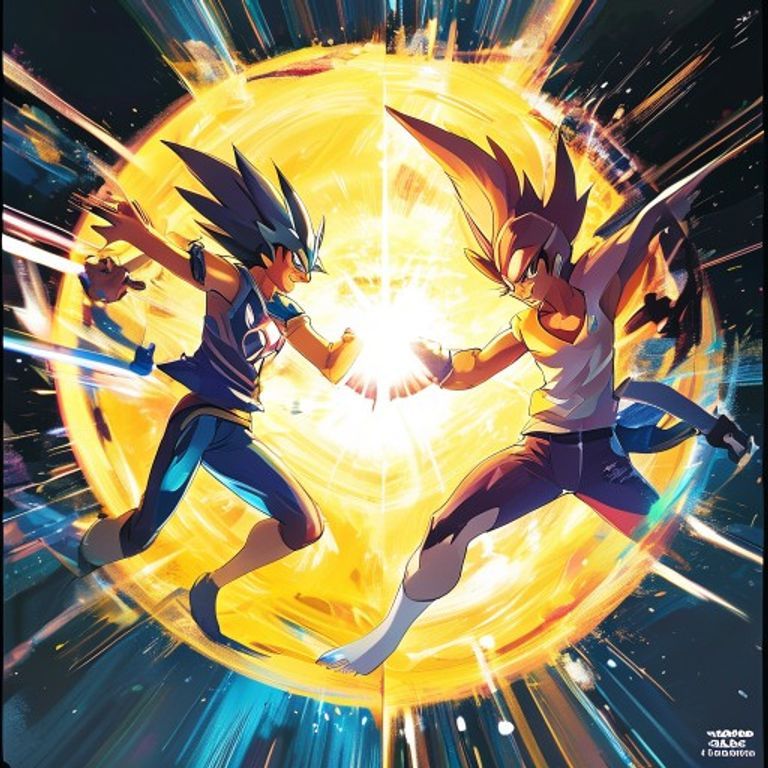
The prompt
Re-render this image as a Pokémon Trading Card Game Tag Team GX card illustration in the Sun-Moon era register (2017-2019 production era), featuring two distinct subjects (either two Pokémon, or a trainer with their signature Pokémon partner) rendered in dynamic compositional relationship. Card format: standard TCG portrait (2.5:3.5), illustration window occupying upper two-thirds, thick yellow-or-silver bordered frame. Dual-subject composition: the two subjects positioned in opposing diagonal geometries, one in lower-left to upper-right thrust, the other in reciprocal upper-left to lower-right counter-thrust, creating a visual X or hourglass geometry across the illustration window. Do NOT position subjects side-by-side or layered (sequential framing). The opposing thrusts must create active collision or energy-exchange at center-frame. Subject 1: rendered mid-action pose (throwing, summoning, striking, leaping) with motion-blur or particle-effect trails showing direction of movement. Subject 2: rendered in counter-motion, reacting, receiving, or colliding with subject 1. Both subjects rendered in modern anime-influenced illustration register (saturated color, dynamic digital-painting technique with crisp highlights and soft shadow-blending). Background: abstract energy or environmental context (electric field, water spray, wind-gust, fire-surge, psychic-aura) matching the type-synergy of the dual-subject, painted in semi-transparent layers with gradient atmosphere. Lighting: dual-directional with each subject lit from its own implied light-source, creating inter-subject shadow contrast. Card-frame elements: HP value top-right area, type-symbols top-left (two type-icons for pair), attack-and-energy-cost bottom third, set-symbol bottom-right, GX-badge suggested near attack-box. Texture: modern semi-glossy card stock, possible textured-foil or holo-window overlay in illustration area. Mood: compositional geometry as argument, two subjects requiring dual-geometry not compromise, the collision as artistic necessity. No legible text on card, no character-names or trademark logos legible, card elements rendered as abstract shape-forms. Preserve the subject, pose, and composition of the source image exactly, change only the medium and rendering.
What it is doing
Tag Team GX cards solved a compositional problem: how to make two subjects read as EQUAL, not primary-and-secondary. The answer was not to split the frame (that just looks like layout failure). The answer was collision-geometry: dual thrusts into the center, reciprocal motion, one subject's energy meeting the other's resistance, creating a visual argument at the center of the card. Applied to any dual-subject, the register asserts: two things require opposing geometry, not compromise. The canvas accommodates both only if both are in motion.
Ways to change it
Pick any of these in the gallery and the choice is added to the prompt you copy.
- Dual-type dial: Pokémon pair matching-type synergy (fire-water collision) vs trainer-Pokémon pair same-element (trainer tossing Pokémon into action) vs legendary-dual same-origin-myth (Kyogre-Groudon, Dialga-Palkia cosmology)
- Collision-geometry dial: opposing diagonal thrusts X-frame (signature tag-team) vs concentric circular geometry (less-common alternative) vs vertical stack with asymmetric weight (rare variant)
- Motion-effect dial: particle trails and energy-exchange visible (signature) vs charged-aura halo around impact zone (austere) vs environmental weather collision (fire meets water steam-burst)
- Era look: Sun-Moon Tag Team look: X-shaped clash, heavy particle bursts, saturated digital paint (signature) vs calmer V-card look: smoother gradients, softer glow, cleaner silver frame vs modern ex look: textured painterly brushwork, muted pastel palette, art bleeding past frame
Style lineage
Learn the visual culture this draws from: Bulbapedia.
Related prompts
See all 31 prompts in the Pokemon-Card grammar