Pokemon-Card / Style prompt
Evolution-Line Three-Stage Triptych
Three Pokémon cards arranged left-to-right showing the same entity at stage-1, stage-2, and stage-3 of evolution. Growth as discipline, not transformation.
Customize this prompt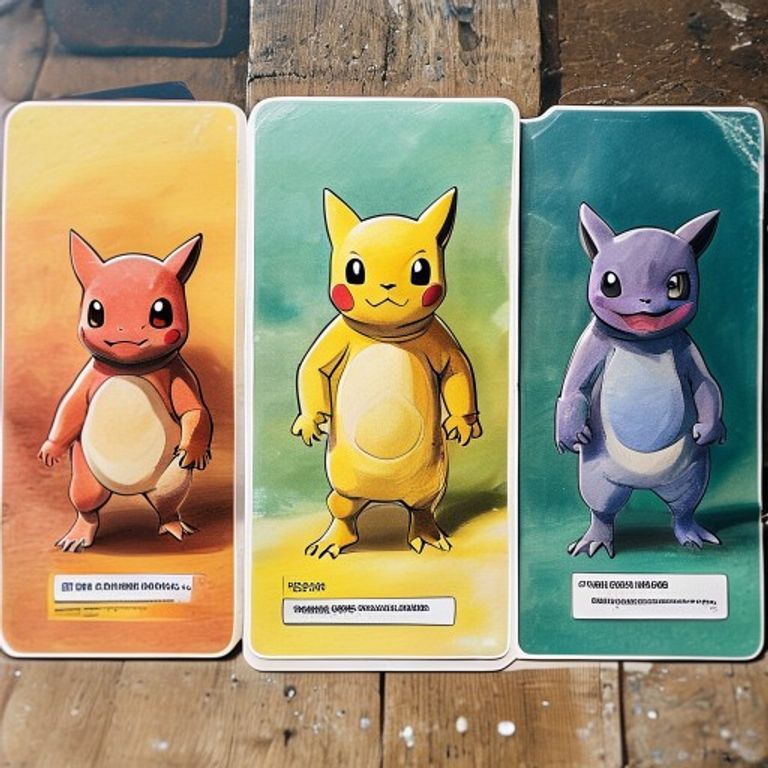
The prompt
Re-render this image as a three-card triptych arrangement of Pokémon Trading Card Game cards showing an evolution-line: three cards laid out left-to-right side-by-side, each showing the same entity at a successive evolution stage (Basic, Stage 1, Stage 2). Card 1 (left): the smallest, youngest form, rendered with rounder proportions, larger eye-to-head ratio, softer color saturation, lower HP value suggested top-right, simple single-attack box. Card 2 (center): the intermediate form, rendered with intermediate proportions, more-defined musculature or feature-definition, mid-saturation color, mid-tier HP, two-attack box with energy-cost shown as colored circles. Card 3 (right): the final form, rendered with full-mature proportions, sharpest feature-definition, deepest color saturation, highest HP, complex multi-attack box with significant energy-cost. All three cards share: same illustration register (painterly watercolor or crisp airbrush, consistent across the triptych), same border-color scheme (yellow base-set or matching era), same illustration-window framing, same lighting direction. Card cardstock: all three cards rendered as physical objects on flat surface (wood table, felt mat, plastic-binder page), slight 3D depth showing card-thickness edges, soft shadow beneath each card. The three cards arranged with small even spacing between them (approximately the width of a card-border between each). Background: shallow depth-of-field blur with warm tone, suggestion of binder-page or collector's table at extreme background blur. Lighting: single soft directional source from upper-screen-left across all three cards uniformly, slight gradient brightness left-to-right or uniform. Mood: growth-as-discipline, the same entity rendered three times revealing the trajectory of becoming, the evolution-line as proof that mastery is iterative-not-spontaneous. No legible text on any card, no specific names, no trademark logos, attack-text rendered as shapes only. Preserve the subject and composition of the source image exactly as the central card's illustration content, with stage-1 and stage-3 variants extrapolated from it. Aspect ratio prefers 16:9 or 3:2 horizontal to accommodate the triptych.
What it is doing
The evolution-line is one of the most under-theorized teaching-objects in pop culture. Three cards, same entity, three stages. The register asserts: growth is not transformation into a different thing, growth is the same thing rendered with more years of work. The triptych makes the trajectory visible. Applied to any contemporary subject undergoing iterative development (the builder, the practitioner, the company at three funding stages, the artist at three career phases), the register encodes the growth-as-discipline mode against the transformation-as-rupture narrative.
Ways to change it
Pick any of these in the gallery and the choice is added to the prompt you copy.
- Spacing dial: tight-adjacent cards almost touching (album-spread) vs even small-gap spacing (signature triptych) vs wide separation each card framed (museum-display register)
- Era-consistency dial: all three same era 1996-base-set (signature) vs each card in era-of-canonical-introduction (chronological-canon) vs all three modern full-art register (contemporary)
- Surface dial: flat table or felt mat top-down (signature) vs binder-page sleeves (collector-archive) vs held in hand fanned-out (intimate)
- Stage-jump dial: Basic-Stage1-Stage2 standard (signature) vs pre-evolution-Basic-Stage1 (early-game variant) vs Stage2-Mega-Gigantamax (modern peak variants)
Style lineage
Learn the visual culture this draws from: Bulbapedia.
Related prompts
See all 31 prompts in the Pokemon-Card grammar