Pokemon-Card / Style prompt
Holographic Foil Pull-Moment Light-Catch
The card held at a tilted angle, light streaking diagonally across the holographic-foil illustration window. The talismanic sacred-marker moment.
Customize this prompt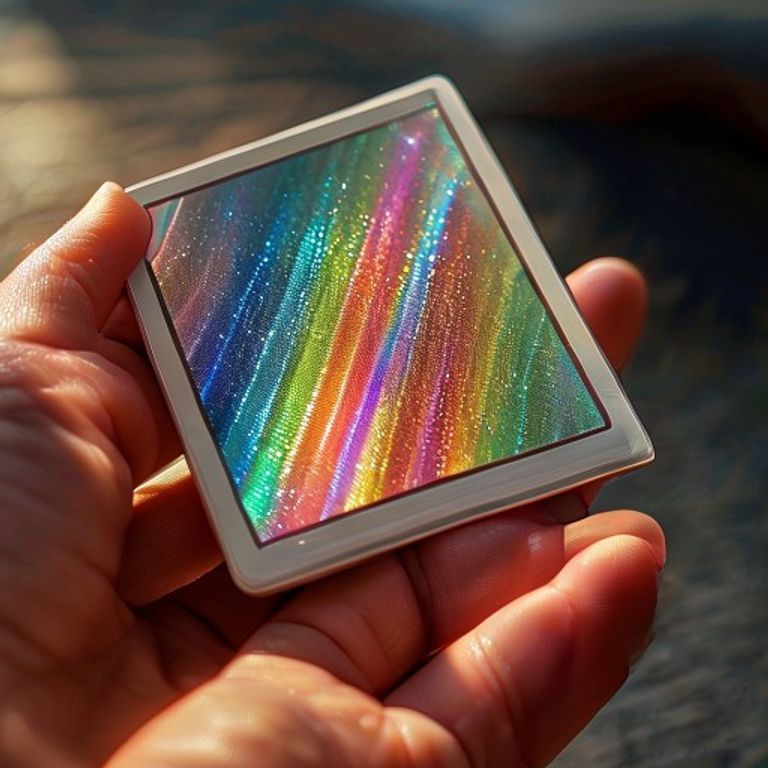
The prompt
Re-render this image as a macro-close-up photograph of a Pokémon Trading Card Game card held at a tilted angle in soft natural light, with the illustration window showing pronounced holographic-foil light-catch effect. Card held by fingertips at lower-frame edge (fingertips visible only at edges, soft-focus, not the subject of the image). Card tilted approximately 30-45 degrees off the camera's perpendicular axis. Illustration window covered in holographic-foil pattern: rainbow-spectrum light-streaks running diagonally across the window in iridescent prismatic bands (cyan-magenta-yellow-green shifting bands), the foil pattern overlaying the underlying illustration with semi-transparency so subject is visible beneath the foil-shimmer. Foil pattern can be: vertical-line cosmos pattern (signature base-set holo), galactic-swirl pattern (Neo-Genesis), reverse-holo dotted pattern (modern reverse-holo), or full-art textured pattern (modern full-art). Card surface catches light with sharp-edged specular highlight running diagonally, the angle of light revealing the foil-iridescence at its peak. Non-foil card frame elements (border, attack-box, set-symbol area) rendered as solid-color and matte, providing visual contrast against the shimmering window. Background: very soft-focus warm indoor light (incandescent or window-warm), suggestion of carpet or wooden table or open booster-pack edge at extreme background blur. Lighting: single soft directional source from upper-screen-left catching the foil at angle, slight rim-light on card edges, deep shadow on opposite side. Mood: the talismanic sacred-marker moment, the pull from the pack that materializes value out of probability, the foil that catches the light as proof-of-rarity. Photography technique: macro lens, shallow depth-of-field on the foil-catch zone, slight chromatic aberration at color-band edges, film-grain or digital-noise subtle. No legible text on card, no specific card-name or trademark, illustration window content abstracted into foil-overlaid form. Aspect ratio matches source.
What it is doing
The holographic-foil pull is one of the foundational rituals of childhood-and-adult collector culture. The card emerges from the pack, tilted toward the light, and the foil shimmers. The register asserts: rarity-as-talisman, the foil as sacred-marker, the pull-moment as materialized-probability. The cardboard becomes asset the instant the light catches the foil. Applied to any contemporary subject undergoing the moment-of-revealed-value (the unboxing, the reveal, the pull), the register encodes the talismanic-materialization mode.
Ways to change it
Pick any of these in the gallery and the choice is added to the prompt you copy.
- Foil-pattern dial: vertical-line cosmos base-set (signature 1996-1999) vs galactic-swirl Neo-Genesis (1999-2003) vs dotted reverse-holo modern (2002-onward) vs textured full-art secret-rare (premium)
- Tilt-angle dial: slight 15-degree tilt (peek-foil) vs moderate 30-45 degree tilt (signature peak-catch) vs extreme 70-degree tilt (max-shimmer, harder to read illustration)
- Light-source dial: warm incandescent indoor (signature childhood) vs cool daylight window-side (collector-grading register) vs single hard spotlight overhead (auction-photography)
- Hand-visibility dial: fingertips only at edges (signature) vs partial hand cradling card (more-intimate) vs card on flat surface, no hand (austere collector-shot)
Style lineage
Learn the visual culture this draws from: Bulbapedia.
Related prompts
See all 31 prompts in the Pokemon-Card grammar