Daido Moriyama Grainy Are-Bure-Boke
Re-render as a high-contrast pushed Tri-X frame: rough, blurred, out-of-focus, the Provoke-era thesis that the medium's "failures" are its honesty.
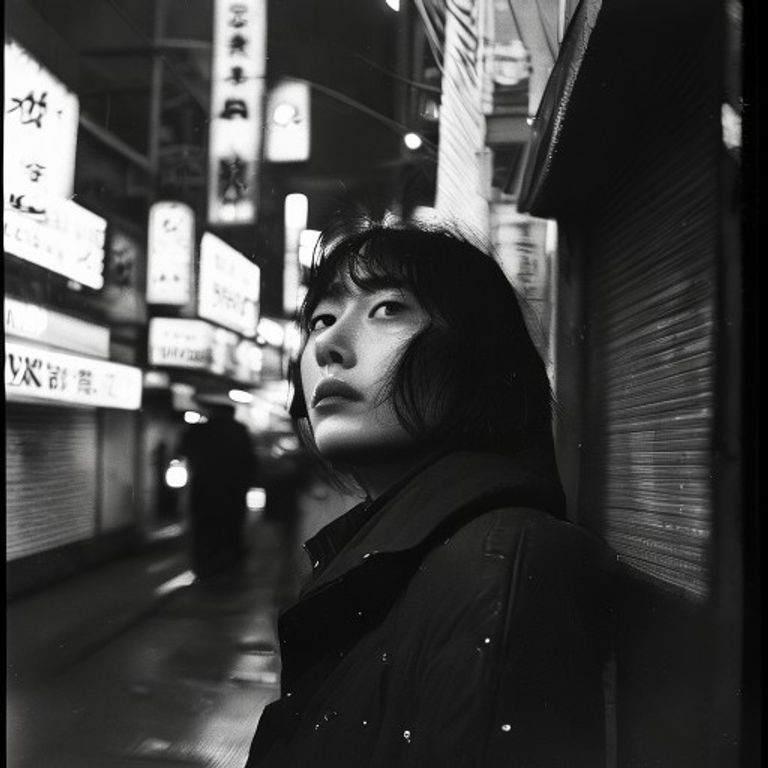
The prompt
Re-render this image as a black-and-white 35mm photograph in the manner of Daido Moriyama and the Provoke-era Japanese photography movement, exposed on Kodak Tri-X 400 pushed two or three stops to 1600 or 3200, developed for high contrast and aggressive grain, printed harsh on grade 4 or 5 paper. Apply the are-bure-boke aesthetic: are (rough texture), bure (camera-motion blur), boke (out of focus). Subject may be partially blurred from camera-shake at slow shutter (1/15 or slower handheld), or out of focus with the background sharp, or rendered with all surfaces obscured by aggressive grain that becomes almost a pattern of its own. Tonality: extreme contrast, near-zero mid-tones, the print falls almost entirely into deep black or paper-white with thin transition zones. Setting: Shinjuku alley after rain, Tokyo backstreet, neon-reflected sidewalk, stray dog or partial figure or shopfront seen at a hip-shot oblique angle. Composition: tilted horizon, off-center, half-cropped, the frame caught while walking rather than composed at a stop. Snapshot energy, not gallery composition. Print quality: small grainy newsprint reproduction feel, or rough silver-gelatin enlargement with visible developer marks acceptable. Mood: post-war Tokyo, restless, the city as fragments, the photographer as wandering animal. Forbid: any clean smooth tonal range, any HDR softness, any color, any visible text in legible form (suggestion of Japanese signage as pure shape and tone is acceptable, but no readable characters and no hallucinated kanji), any watermark, any logo. Preserve the subject, pose, and composition of the source image exactly, change only the medium and rendering.
What it is doing
Provoke argued that photography's claim to objectivity was a lie and that grainy, blurred, out-of-focus images told a more honest truth about subjective vision than sharp documentary frames. Re-rendering in this register is a refusal of the high-resolution everything-is-evidence regime of contemporary phone photography.
Tuning knobs
- Grain dial: `Tri-X normal push to 1600` vs `aggressive 3200 push` vs `near-solarized extreme`
- Blur dial: `subject sharp, background blurred` vs `subject blurred, background sharp` vs `everything blurred from camera-shake`
- Setting dial: `Shinjuku neon alley rain-wet` vs `daytime backstreet` vs `interior bar low-light` vs `train platform motion`
- Angle dial: `hip-shot tilted` vs `low ground-level upward` vs `eye-level oblique`
Style lineage
Learn the visual culture this draws from: Tate.
Related prompts
See all 10 prompts in the Photography grammar · Open in the gallery
Get the free sample. The intro plus the first three chapters of The Liberation Engine, delivered as a PDF. The full book and the complete 557-prompt method are the paid edition.