Gregory Crewdson Cinematic-Tableau
Re-render as an 8x10 staged twilight tableau, lit like a Hollywood film set, the implied narrative more important than any single object in frame.
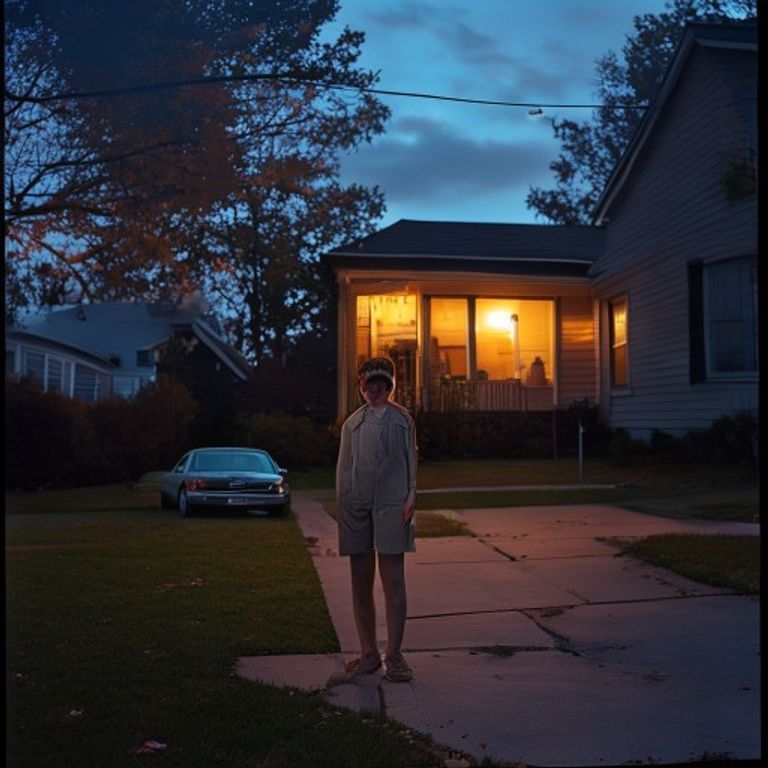
The prompt
Re-render this image as a large-format staged photograph in the manner of Gregory Crewdson, exposed on 8x10 inch color negative, lit with a full Hollywood lighting crew load-in: ambient practicals (porch lamp, lit window, car interior dome) at warm tungsten 3200K, plus a key light suggesting either streetlamp sodium-vapor amber or moonlight cool blue 5600K, plus rim and back lights separating the subject from background. Time of day: civil twilight (post-sunset, sky still holding deep blue and orange band on horizon), or pre-dawn equivalent. Setting: small American town suburban exterior (cracked driveway, weathered clapboard house, telephone pole, low-slung sedan), or interior with strong window casting outside-light inward, the kind of liminal residential geography that implies a narrative just-before or just-after. Subject is rendered with theatrical staging: posture frozen mid-action or in trance-like stillness, eyes often unfocused, the figure caught in a private moment that suggests a story we have walked in on. Color: muted, slightly desaturated, with selective warm/cool color contrast (sodium amber vs twilight blue) that reads as Hollywood color-grading. Detail: every leaf, crack, peeled paint flake, dropped object on the lawn rendered sharp at f/22 hyperfocal, the resolution forcing the viewer to inventory the scene for clues. Mood: suburban gothic, latent menace or sorrow, the single still frame from a film that does not exist but feels remembered. Forbid: any visible text on signage (no foreign characters, no hallucinated brand logos), any watermark, any obvious AI compositing artifact, any cheerful flat lighting. Preserve the subject, pose, and composition of the source image exactly, change only the medium and rendering.
What it is doing
Crewdson uses a film crew to make one still photograph. The thesis is that a photograph can imply an entire narrative if the lighting and staging do the work that screenwriters usually do. Re-rendering in this register asserts that a single frame can carry as much weight as a feature film.
Tuning knobs
- Time dial: `civil twilight blue+orange band` vs `pre-dawn cool` vs `interior with window-lit outside-blue`
- Color-grade dial: `sodium amber vs twilight blue split` vs `monochrome cool desat` vs `Kodak Vision3 warm filmic`
- Setting dial: `suburban driveway` vs `kitchen with window` vs `motel parking lot` vs `forest edge with house in background`
- Narrative-implication dial: `subject mid-trance, no action` vs `subject mid-gesture, frozen` vs `subject discovered by viewer, unaware`
Style lineage
Learn the visual culture this draws from: The Criterion Collection.
Related prompts
See all 10 prompts in the Photography grammar · Open in the gallery
Get the free sample. The intro plus the first three chapters of The Liberation Engine, delivered as a PDF. The full book and the complete 557-prompt method are the paid edition.