Guerilla / Style prompt
Maori Land March Hikoi Documentary Field Image
The 1975 Whina Cooper hikoi land-march register, walking thousands of kilometers north to south as territorial reclamation, documented in 35mm newsprint photography.
Customize this prompt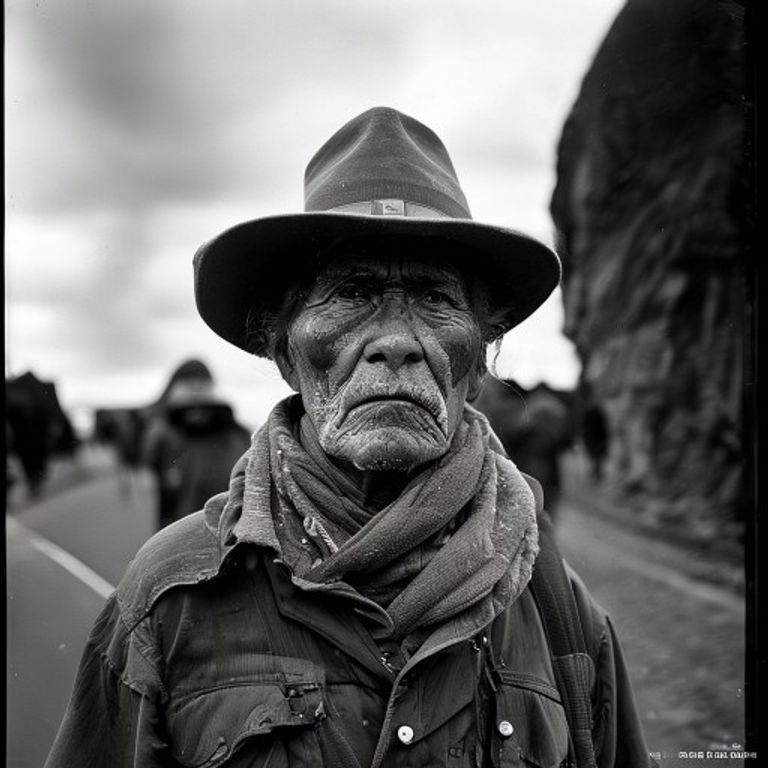
The prompt
Render in the visual register of a 1975 documentary photograph of the Maori land march hikoi (the Whina Cooper led march from Te Hapua to Wellington, September to October 1975). Medium: 35mm black-and-white press photography, grainy, fast film pushed for available light, the documentary lineage of New Zealand wire photographers and Marti Friedlander. Palette: full grayscale tonal range, deep blacks in shadow under broad-brimmed hat, mid-grey weathered face skin, bright white road dust and overcast sky, the deep textural grey of woolen Swanndri jackets and military-surplus boots. Texture: visible 35mm grain, the slight softness of pushed Tri-X film, road dust on boots and trouser hems, the wear of wool fabric, hand-painted placard surfaces rendered as abstract pale-on-dark texture only with no legible text. Lighting: flat overcast North Island sky, no harsh shadows, the documentary clarity of midday cloud cover. Mood: the dignity of a march that walked the entire length of an island to claim what was already theirs, the quiet endurance of women elders setting the pace, the slow accretion of moral authority over kilometers of road. Do not render any legible text, slogans, placard words, logos, named hate symbols, watermarks, or defamatory likeness of real persons; all placard contents and patches are abstract painted shapes only. Preserve the subject, pose, and composition of the source image exactly, change only the medium and rendering.
What it is doing
Walking is the oldest sovereignty claim. The 1975 hikoi worked because a thousand people walking a road for a month produces a fact that no court ruling can reverse: the road and the land it crosses have been retraversed by the people who were here first. Settler states depend on the ahistorical present tense; the march imposes the historical past tense on the same kilometers of asphalt. New Zealand has spent fifty years catching up to the legal implications of that walk. The body in motion across contested ground is the strongest possible witness.
Ways to change it
Pick any of these in the gallery and the choice is added to the prompt you copy.
- Stage of march: north-island-rural vs urban-Auckland vs Wellington-arrival
- Weather: clear southerly vs overcast typical vs Auckland-rain
- Cadre composition: elder women vanguard vs multi-generational vs youth-trailing
- Distance from camera: intimate portrait vs medium-march vs wide-column
- Film stock: fine-grain Tri-X at box speed, smooth midtones, gentle contrast vs Tri-X pushed two stops, coarse grain, deep blacks, slight softness (signature) vs pushed to 3200, heavy clumped grain, near-silhouette shadows, blown white sky
- Era reference: 1975 original vs 2004 Foreshore-Seabed hikoi vs 2024 Te Tiriti hikoi
Style lineage
Learn the visual culture this draws from: Whina Cooper (Maori leader, 1975 Land March).
Related prompts
See all 33 prompts in the Guerilla grammar