Guerilla / Style prompt
Mau Mau Forest Oath
1952 to 1960 Kenya Mau Mau (KLFA) register: Aberdare and Mount Kenya forest-cadre documentary aesthetic, Kikuyu Land and Freedom Army, dreadlocked fighters and oath-ceremony chiaroscuro.
Customize this prompt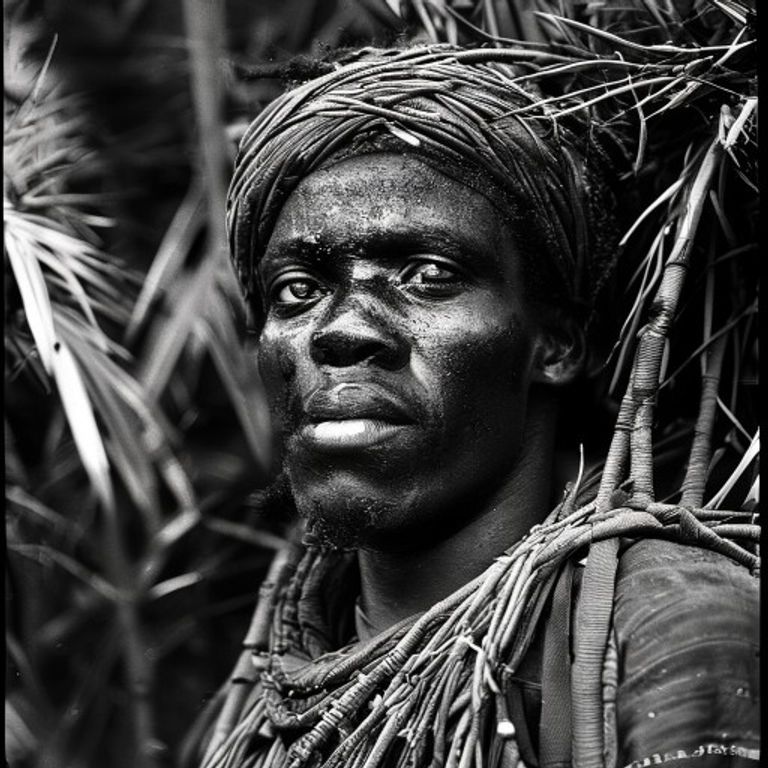
The prompt
Re-render this image in the visual register of 1952 through 1960 Kenya Mau Mau (Kenya Land and Freedom Army) documentary and period-press photography (the body of photographic and illustrated work depicting Kikuyu forest fighters operating in the Aberdare range and the Mount Kenya forest during the Emergency declared by the British colonial administration, drawing partly on documentary sources and partly on post-independence Kenyan reconstructive imagery). Mid-twentieth-century 35mm field documentary photograph aesthetic in monochrome panchromatic black and white, with secondary period magazine-illustration register available. Palette pure monochrome with high-contrast tonal range, deep forest-canopy blacks and dappled-light highlights from broken canopy, the gray scale skewing toward atmospheric chiaroscuro from broken Aberdare light. Subject and surface architecture: high-elevation African rainforest (bamboo grove, giant heather, mountain mist, podocarpus and hagenia trees, mossy log architecture), forest-cadre figures in mixed dress (animal-skin cape, knitted balaclava cap, repurposed British army surplus, captured Lee-Enfield rifles, simi machetes and panga knives, occasional homemade firearm), characteristic dreadlocked hair on long-resident forest fighters (the matted hair a result of the bush-living conditions and later adopted as identity-marker). Surface: 1950s panchromatic film grain, occasional emulsion mottling from field-processing in clandestine conditions, slight motion blur, period-camera focus drift, sun-fade on high-key passages. Light: dappled forest-canopy light filtered through bamboo (atmospheric variant) or low-angle mountain dawn casting long figure-shadows along forest path (golden variant) or night oath-ceremony firelight clustered in deep forest clearing (intimate ritual variant) or overcast Aberdare highland mist (atmospheric variant). Composition: small-cadre groups of three to fifteen figures in forest, oath-ceremony compositions with figures clustered in a circle around a central fire or ritual element, occasional medium-range portrait of single fighter with dreadlocks and machete or rifle, paired-figure compositions of forest-cadre-and-passive-wing-courier handover. Mood: forest-base-area autonomy, ritual-oath formation binding the cadre to land and ancestor, the forest as both physical sanctuary and political-symbolic Kikuyu motherland, the British colonial administration unable to follow into either. Strictly no on-canvas text, no Swahili or Kikuyu lettering, no KLFA or Mau Mau letter-marks, no slogans, no signature, no village-sign legibility, no later commemorative dates, no watermark. Preserve the subject, pose, and composition of the source image exactly, change only the medium, register, and tonal treatment. Aspect ratio matches source.
What it is doing
Mau Mau understood something Lansdale spent his Philippine career trying to teach: the oath is the recruitment mechanism, the forest is the base area, and the political-symbolic charge of returning to ancestral land is worth more than any tactical advantage. The British counter-insurgency under Erskine and later Templer-style operations ultimately defeated the forest cadres militarily, but the political defeat was already irreversible by 1960. The aesthetic encodes this duality, the dreadlocked fighter is simultaneously a soldier and a returned ancestor, the oath-ceremony chiaroscuro is the recruitment poster the colonial administration could not counter.
Ways to change it
Pick any of these in the gallery and the choice is added to the prompt you copy.
- Forest dial: Aberdare bamboo high-elevation vs Mount Kenya hagenia podocarpus vs forest-edge cultivated borderland vs forest-village shamba transition
- Phase: early fighters, short hair, ragged surplus coats, few weapons, makeshift forest camp vs seasoned cadre, long dreadlocks, animal-skin capes, captured rifles, dense bamboo hideout (signature) vs barbed-wire fortified village, British patrols, guarded villagers, cleared bare hillside vs staged post-independence reconstruction, posed heroic portraits, cleaner sharper film
- Composition dial: lone fighter portrait vs small forest squad three to seven vs oath ceremony circle around fire vs passive-wing courier handover forest-edge
- Light dial: dappled canopy bamboo filtered vs golden hour forest path long shadows vs night oath ceremony firelight ritual vs overcast highland mist atmospheric
- Register dial: documentary 1950s field photography vs period British press illustration vs post-independence Kenyan reconstructive vs mixed photo-illustration composite
Style lineage
Learn the visual culture this draws from: Mau Mau (Kikuyu nationalist movement, Kenya 1950s).
Related prompts
See all 33 prompts in the Guerilla grammar