Guerilla / Style prompt
EZLN Masked Spokesperson Balaclava Communiqué (Chiapas, 1994)
Boyd's OODA loop weaponized. The state cannot capture an image because the image refuses to disclose who is inside it. The mask is the thesis.
Customize this prompt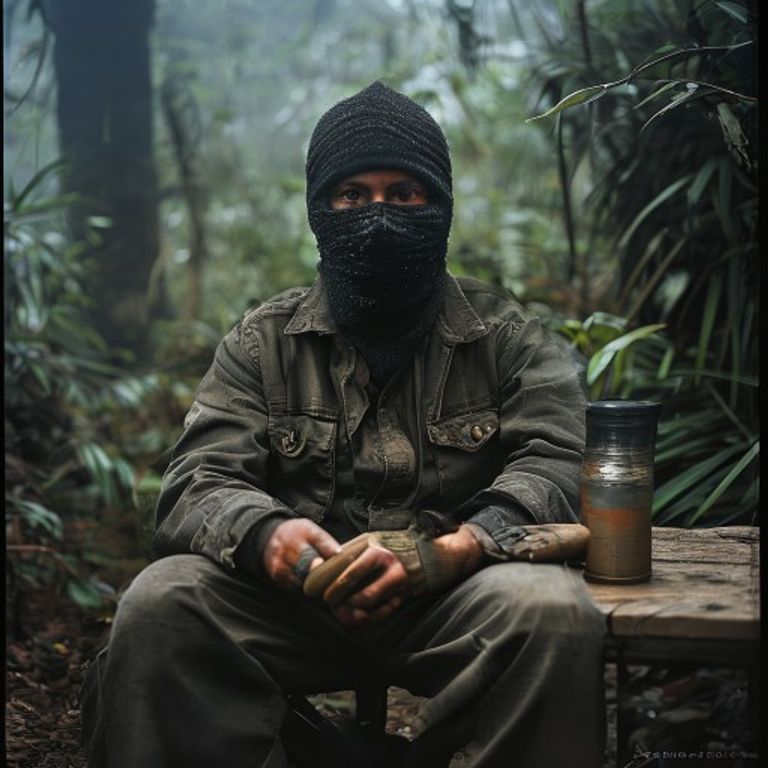
The prompt
Re-render this image as a photograph from the Zapatista uprising in Chiapas, Mexico, circa 1994 to 2001. Subject is rendered with a black wool balaclava covering the entire face except for the eyes and lips, the rest of the body in ordinary mixed civilian and field clothing (denim, work shirt, simple boots, a worn jacket). Setting: cloud forest of southern Mexico, soft indirect light filtering through canopy, atmospheric mist in middle distance, the green of the jungle desaturated by overcast humidity. The subject is seated or standing in a relaxed but intentional posture, holding a humble object (a hand-rolled cigarette, a wooden pipe, a tin cup, a paperback book, a hand-written letter), not a weapon. Background: small wooden table, kerosene lamp, jungle vegetation pressing in. Light: soft 4000K natural daylight under canopy, slight grain of film, the texture of a documentary 35mm photograph by a foreign journalist granted access. Mood: the figure who refuses to be identified, anonymity as political stance, the communique as the only voice, the body present and the identity withheld. No text, no EZLN flag, no specific Zapatista iconography, no rifle in frame. Preserve the subject's pose and composition exactly, AND apply the black balaclava covering the face regardless of the source subject's actual face. Aspect ratio matches source.
What it is doing
A masked Zapatista spokesperson converted anonymity into political power. The mask is the thesis: we will not show you a face for you to celebritize, vilify, assassinate, or coopt. The image refuses the state's primary tool (identification) and forces the state to engage the message rather than the messenger. Applied to a contemporary subject, the register asserts: this person speaks for a position, not as a brand.
Ways to change it
Pick any of these in the gallery and the choice is added to the prompt you copy.
- Object held: pipe (philosophical) vs paperback book (intellectual) vs tin cup (campesino solidarity) vs pen and notebook (the communique itself)
- Setting dial: cloud forest interior (Chiapas signature) vs simple wooden cabin interior (camp HQ) vs village plaza dusk (public communique moment)
- Posture dial: seated contemplative vs standing addressing off-frame audience vs walking through forest, half-turned to camera
- Era dial: 1994 uprising look: olive drab field shirt, web belt, rigid upright military stance vs 2001 caravan look: civilian jacket and work shirt, relaxed open posture, letter in hand vs late 1990s camp look: faded denim, seated at the lamp-lit table, pipe in hand
Style lineage
Learn the visual culture this draws from: Wikipedia.
Related prompts
See all 33 prompts in the Guerilla grammar