Guerilla / Style prompt
Chinese Revolutionary Woodcut (Lu Xun era, 1930s)
Mao stage-1 organize-phase grammar. The image looks like cheap labor art. It reads as a meeting summons to those who have eyes.
Customize this prompt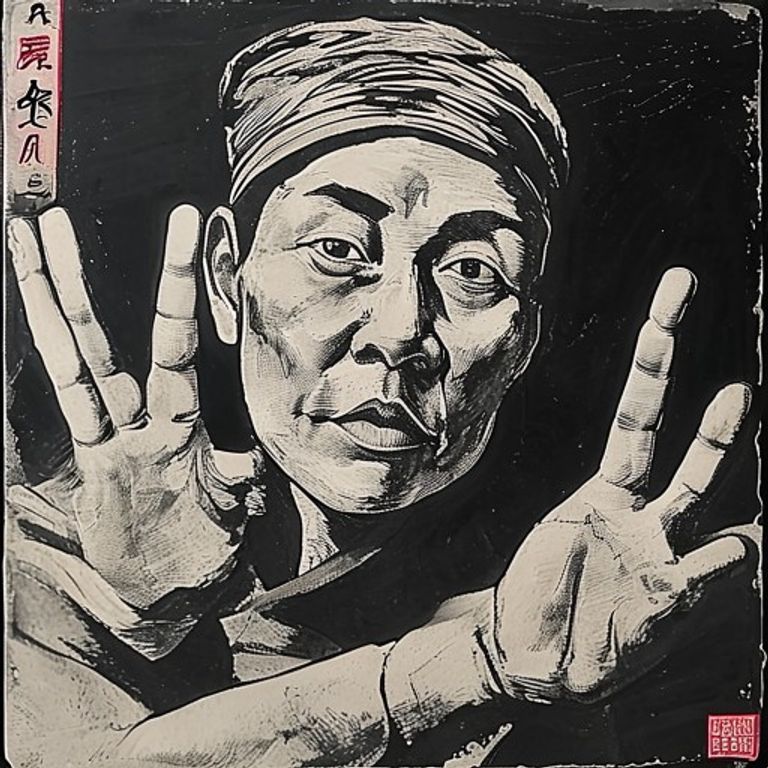
The prompt
Re-render this image as a 1930s Chinese revolutionary woodblock print in the lineage of the Lu Xun-supported Modern Woodcut Movement (Li Hua, Hu Yichuan, Jiang Feng). Carved-block aesthetic, hand-printed on rough rice paper, black ink only, no color. Bold simplified shapes built from gouged lines, areas of pure black against pure paper-white, no halftone, no gray midtones, only carved positive and negative space. Lines deliberately crude: visible chisel marks, slight uneven inking, registration drift, the proudly handmade rather than industrial. Subject rendered with anatomical exaggeration toward expressive purpose: hands and feet enlarged, faces simplified to essential planes, posture conveying urgent purpose without theatrical heroism. Composition: low horizon line, subject occupying lower two-thirds of frame, looming proximity to viewer as if photographed at close range. Mood: clandestine urgency, peasant intelligence, the cell-meeting visible only to those who already know what to look for. No text, no Chinese characters, no specific party symbols, no rifle iconography. Preserve the subject, pose, and composition of the source image exactly, change only the medium and rendering. Aspect ratio matches source.
What it is doing
The Lu Xun woodcuts looked like cheap peasant art to the Kuomintang censors. They were intelligence packets to the cells. The register operates on a recognition-asymmetry: surface-readable as folk craft, interior-readable as organize-phase summons.
Ways to change it
Pick any of these in the gallery and the choice is added to the prompt you copy.
- Crudeness dial: early 1931 self-taught (rougher) vs 1937 mature Yan'an period (slightly more refined)
- Composition dial: single figure portrait vs group of three to five figures in tableau vs figure with one tool or object central
- Atmosphere dial: add faint background suggestion of village rooftops or distant industrial smoke for setting context
- Carving dial: bold wide gouges, big flat black masses vs fine parallel hatching cuts vs white-line cutting, the figure drawn in carved white on solid black
Style lineage
Learn the visual culture this draws from: Britannica.
Related prompts
See all 33 prompts in the Guerilla grammar
Read the full free book. All thirty-six chapters and the companion 657-prompt image library are free.