1980s-Lineage Multilayer Grayscale Aerosol-Stencil Street Portrait
The 3-to-5-layer aerosol-stencil portrait register, 1980s Parisian lineage, photorealistic-from-distance built from registered acetate cuts.
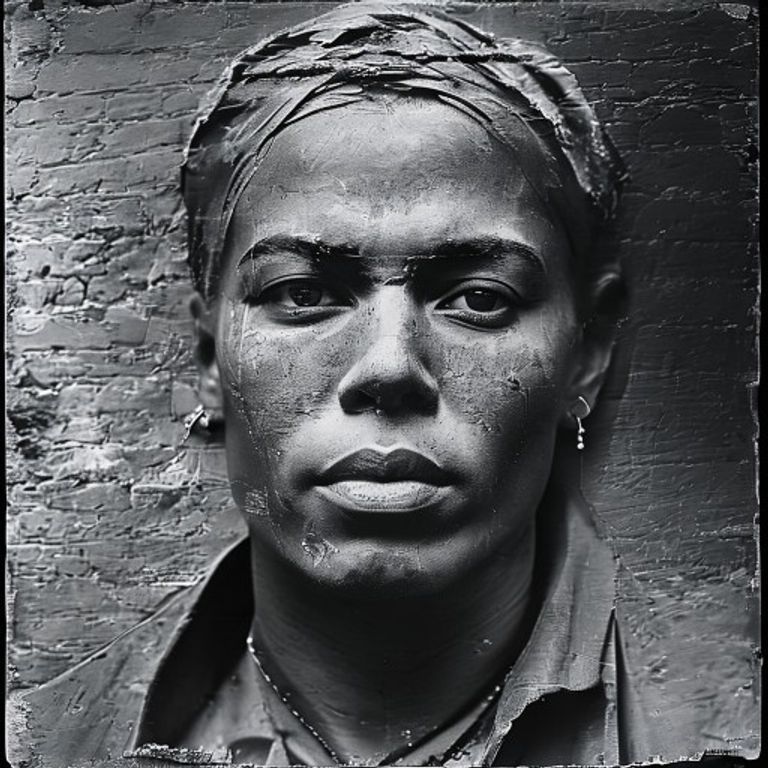
The prompt
Render in the visual register of a multilayer aerosol-stencil street portrait in the lineage of 1980s Parisian street stencils and the subsequent satirical stencil-portrait wave. Medium: three to five separate hand-cut acetate or cardboard stencil layers, each sprayed in registration over the previous with a different value of gray, producing a posterized portrait that reads as photographic from across the street and as flat-cut shapes up close. The stencils are applied to a rough urban wall surface (brick, render, peeling poster-pasted billboard) leaving slight overspray halos around each cut. Palette: photographic-grayscale only, ranging from solid black through three values of mid-gray to the substrate-color of the wall as the brightest highlight, no full white because the substrate provides it. Texture: rough brick mortar or peeling paste-up substrate visible through and around the portrait, characteristic stencil overspray fuzz at the edges of every cut, occasional drip where aerosol pooled too thick. Lighting: ambient urban daylight, no special lighting needed because the medium reads at distance. Mood: the dignity of the medium that lets one person produce a hundred near-identical large portraits in a city overnight, the political speed of reproducibility weaponized against unique-object commodification. Do not render any legible text, signatures, tags, dates, logos, watermarks, named hate symbols, or defamatory likeness of any real living or historical person; the portrait must be the source-image subject only, treated as an anonymous formal study. Preserve the subject, pose, and composition of the source image exactly, change only the medium and rendering.
What it is doing
Stencil portraiture solved the speed problem that limits all hand-painted political street art: one person with five acetate sheets and three cans of aerosol can hit fifty walls in a night. The reproducibility is the politics. A unique mural is a luxury; a reproducible stencil is a movement. Parisian street stencils showed in 1981 what the digital-art world rediscovered in 2007: when the cost of the next copy approaches zero, the medium becomes a Schelling point for distributed coordination. Every well-cut stencil is a coordination protocol that costs the state more to suppress than it costs the maker to deploy.
Tuning knobs
- Layer count: 3-layer simple vs 4-layer standard vs 5-layer photoreal
- Wall substrate: brick vs render vs paste-up poster vs metal shutter
- Weathering: fresh-overnight vs weeks-old vs months-faded
- Overspray halo: tight vs medium-fuzz vs heavy-aura
- Drip incidence: none vs occasional vs deliberate
- Era: 1981 Parisian street-stencil original vs 2003 satirical-stencil peak vs contemporary
Style lineage
Learn the visual culture this draws from: Wikipedia.
Related prompts
See all 15 prompts in the Graffiti-Mural grammar · Open in the gallery