Graffiti-Mural / Style prompt
Mexican Day of the Dead Mural
Oaxacan and Mexico City community-mural register: Day of the Dead and Posada-calavera visual grammar carried onto contemporary street walls, marigold orange and cempasuchil purple.
Customize this prompt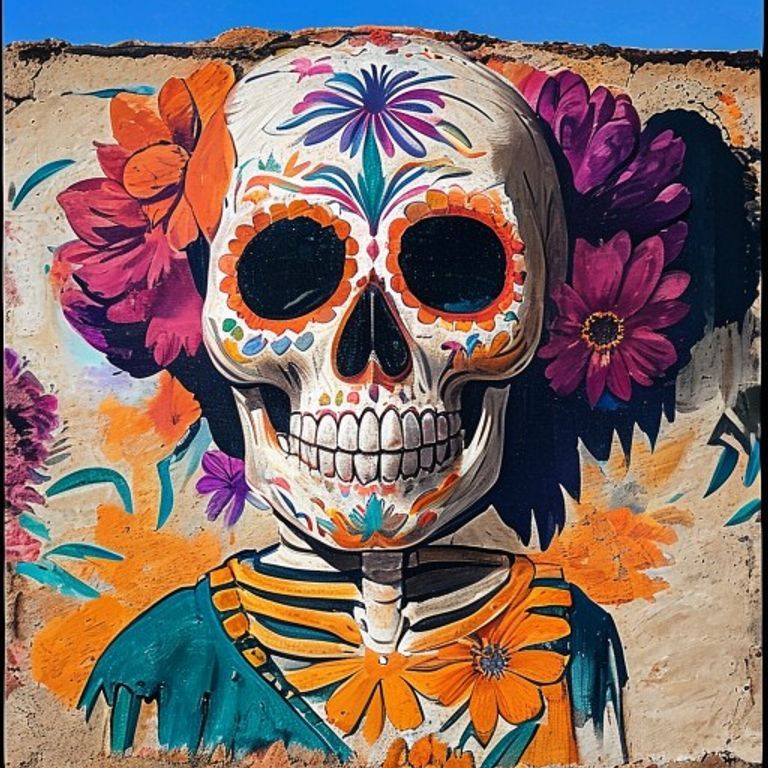
The prompt
Re-render this image in the visual register of contemporary Mexican community Day of the Dead murals (the body of exterior community-wall work produced annually around Dia de los Muertos in Oaxaca, Mexico City, Puebla, and migrant-community walls in Los Angeles and Chicago, descending from the Jose Guadalupe Posada calavera tradition through the Taller de Grafica Popular into present community-mural practice). Exterior community-wall mural aesthetic: acrylic and house-paint on rendered concrete or adobe, large-scale composition occupying an entire one or two-story wall, painted collaboratively by community art collectives. Palette saturated: cempasuchil marigold orange, papel-picado magenta, deep purple, bone-cream white, terracotta red, with strong black contour line and accents of cobalt blue, leaf green, and gold. Surface texture: rough adobe or rendered concrete substrate visible through the paint, occasional crack repaired with darker patch-paint, weathered passages where summer sun has bleached pigment toward the rose end. Rendering: Posada-lineage calavera figuration (skeletal figures dressed in everyday clothing engaged in everyday activities), strong black contour over flat color zones, decorative-pattern fill within color zones (papel-picado cutwork motifs, embroidered-textile motifs, sugar-skull floral motifs). Background field organized as papel-picado banner pattern or as repeating marigold flower-grid. Light: flat sun-bleached daylight, the mural photographed from the street, slight perspective from a passerby angle. Composition: dense, busy, often friezelike with multiple figures occupying a horizontal procession, the visual rhythm reading as a celebration not a memorial. Mood: ancestor-honoring, joyful-melancholy, community-as-memory-keeper, the wall as ofrenda for those the community refuses to forget. Strictly no on-canvas legible text, no Dia de los Muertos lettering, no individual names of the dead, no political party marks, no muralist signatures, no slogans, no watermark. Preserve the subject, pose, and composition of the source image exactly, change only the medium, palette, and surface treatment. Aspect ratio matches source.
What it is doing
The Day of the Dead mural is community-memory infrastructure: the wall remembers what the state forgets. Lansdale would recognize the hearts-and-minds mechanism, the visual grammar of celebration disarms the politics of remembrance, the ancestor mural functions simultaneously as folk-art and as live political claim about which deaths the community refuses to release into administrative oblivion. The marigold and the calavera are the delivery mechanism, the memory is the payload.
Ways to change it
Pick any of these in the gallery and the choice is added to the prompt you copy.
- Region dial: Oaxacan saturated marigold vs Mexico City urban-monumental vs Puebla pottery-floral motif vs LA migrant-community fusion
- Calavera-density dial: single monumental calavera figure vs paired Catrina-and-Catrin vs procession frieze multiple figures vs pure floral no calavera
- Background dial: papel-picado cutwork repeating vs marigold flower-grid vs night-sky with stars vs plain wall edge to edge
- Surface dial: fresh annual repaint vivid vs weathered one-year-old vs multi-year palimpsest layers vs pristine community-art-program newer
- Mood: dancing calavera crowd, marigold orange and magenta at full blaze vs lone mourning figures at candlelit ofrenda, deep purple and dusk blue vs named portraits of the lost among calaveras, protest banners, stark black vs dense papel-picado and sugar-skull pattern filling every surface
Style lineage
Learn the visual culture this draws from: Britannica.
Related prompts
See all 15 prompts in the Graffiti-Mural grammar