Shepard Fairey OBEY Propaganda Stencil
Late-1990s through 2010s Shepard Fairey OBEY register: red-cream-black constructivist propaganda-style wheatpaste and stencil, signature ornament-laden geometric border.
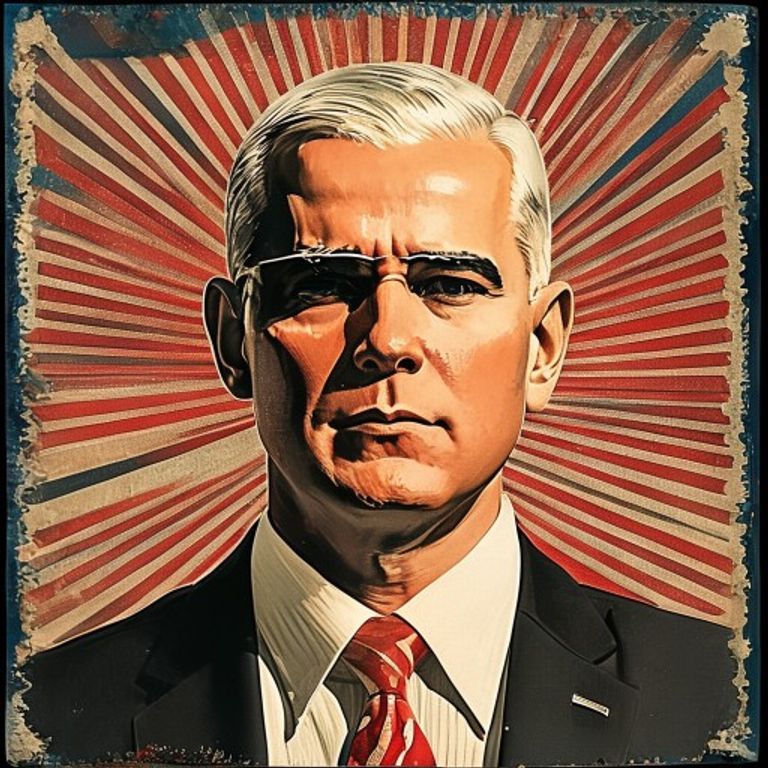
The prompt
Re-render this image in the visual register of late 1990s through 2010s Shepard Fairey OBEY Giant work and Obama-Hope-era poster work (the body of wheatpasted street poster and stencil work that ported Soviet constructivist and Cuban OSPAAAL poster grammar into American street art and gallery practice). Wheatpaste poster on urban substrate aesthetic, or multi-layer stencil on plywood or concrete, with a heavy printed-poster reproduction quality. Palette restricted to a tight three-color stack: brick red, cream or warm beige, and matte black, with occasional accent of teal or olive on long-form posters. Every composition framed by a heavy ornamental border: art-deco rays, constructivist diagonal banners, gear-and-wheat motifs, the border itself reading as half the design weight. Rendering: photographic source reduced to two or three flat tonal values with hard posterization edges, no smooth gradients, every face rendered as flat planes of red over cream over black, the propaganda-poster reduction. Surface: weathered wheatpaste with edge lifting, multiple poster layers underneath, torn corners showing prior layers, occasional spray-tag bleeding through, the wall as palimpsest. Light: flat printed-poster light, no atmospheric depth, the figure backlit by an abstract ray-pattern radiating from behind the head. Composition: centered monumental portrait or icon, ornamental border framing the central figure, radiating sunburst or banner field behind the figure, symmetric or near-symmetric mirror composition. Mood: deliberately ambiguous propaganda, the poster looks like it commands something without specifying what, the Bernays-grade signature symbol functioning as a brand without a product. Strictly no on-canvas legible text, no OBEY lettering, no GIANT lettering, no Andre the Giant face, no HOPE lettering, no slogans of any kind, no signature, no copyright mark, no watermark. Preserve the subject, pose, and composition of the source image exactly, change only the medium, palette reduction, and ornamental border treatment. Aspect ratio matches source.
What it is doing
The OBEY project is the cleanest twentieth-century demonstration of Bernays' core insight: a symbol does not need meaning to acquire power, it only needs saturation. Shepard Fairey pasted a face with a one-word command on enough walls in enough cities that the symbol started doing work before anyone could explain what it meant. The propaganda-poster grammar is not nostalgia, it is operational, it tells the viewer this is a command without naming the commander. The Obama-Hope poster proved the technique scales.
Tuning knobs
- Palette dial: `pure red-cream-black` vs `red-cream-black with teal accent` vs `red-cream-black with olive accent` vs `monochrome cream-and-black no red`
- Border dial: `art-deco rays heavy` vs `constructivist diagonal banners` vs `gear-and-wheat motif` vs `minimal thin border` vs `no border edge to edge`
- Reduction dial: `two-tone flat posterize` vs `three-tone subtle gradient` vs `four-tone near-photographic` vs `single-tone silhouette only`
- Surface dial: `clean printed-poster digital` vs `weathered wheatpaste edge-lift` vs `multi-layer palimpsest wall` vs `multi-layer stencil on plywood`
- Composition dial: `centered monumental portrait` vs `symmetric mirror icon` vs `diagonal constructivist composition` vs `radial sunburst centered`
Style lineage
Learn the visual culture this draws from: Shepard Fairey (American street artist, born 1970, founder of OBEY Giant).
Related prompts
See all 15 prompts in the Graffiti-Mural grammar · Open in the gallery