Ghibli-Meme / Style prompt
Laputa Robot-Gardener Frame (Castle in the Sky, 1986)
The old battle-robot, now overgrown with moss, gently placing a flower on a tombstone or tending a bird-nest. The noble guardian of nothing.
Customize this prompt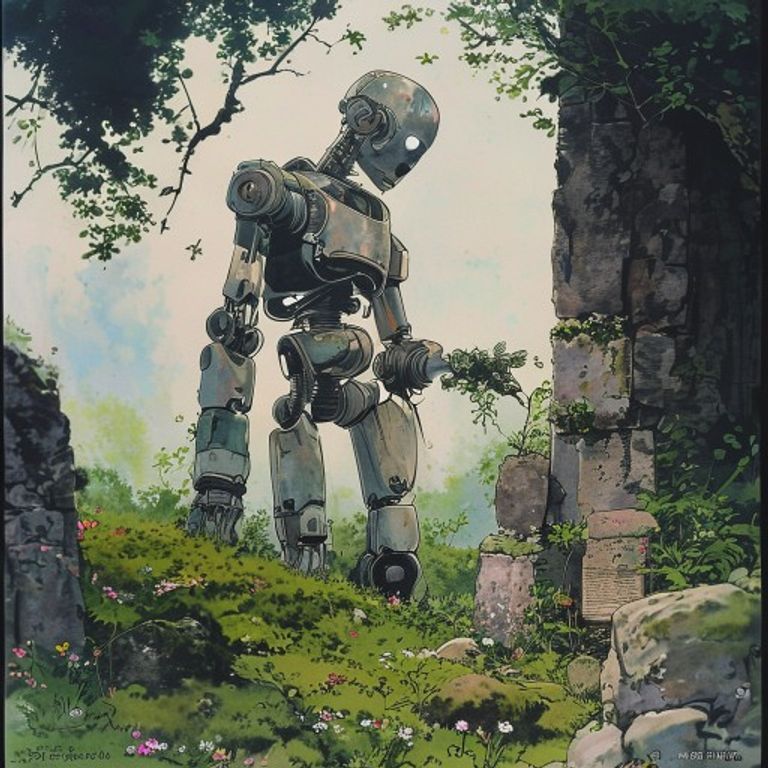
The prompt
Re-render this image as a frame from Studio Ghibli's Castle in the Sky (1986), expressive hand-painted animation direction, verdant watercolor backgrounds, cel-on-acetate production. Subject is a tall ancient robot figure (humanoid silhouette, weathered metal plate, joint-and-rivet construction, no glowing eyes, posture gentle and stooped slightly) standing or kneeling in a garden setting. Moss and vines wrap across the robot's torso and arm joints. One mechanical hand extended in a gesture of careful tending: placing a small flower on a stone marker, holding a small bird, or cradling a young plant. Background: garden ruins overgrown with wildflowers and grasses, broken stone walls, a single ancient tree branch arcing into upper frame, soft watercolor with visible wet-on-wet pooling. Lighting: golden-hour warm directional from upper-screen-right, soft shadow on opposite side of robot, the entire scene quiet and low-contrast. Cel-animation linework: clean single-weight ink, slight imperfection at line ends, the robot rendered with confident mechanical-but-organic line quality. Mood: the noble guardian of nothing, the obsolete weapon that has chosen the longest-quietest patience, gentle attention to small living things in the absence of any human observer or instruction, the machine that has outlived its purpose and invented a better one. Composition leaves negative space at upper sky and lower foreground suitable for caption insertion. No legible text, no studio watermark. Aspect ratio 16:9 matching source. Preserve the subject and composition of the source image exactly, change only the medium and rendering.
What it is doing
The Laputa robot-gardener is the most morally serious figure in the film. An ancient battle-machine, obsolete, unsupervised, has chosen to tend a garden instead of rust. There is no audience. No one is paying it. It does the work because the work is the work. Applied to any contemporary subject doing the right thing without recognition, the register asserts: the noble guardian of nothing is more sovereign than the celebrated guardian of something, because the absence of audience proves the authenticity of the act.
Ways to change it
Pick any of these in the gallery and the choice is added to the prompt you copy.
- Tending-action dial: placing flower on stone marker (signature, max-poignant) vs cradling small bird (gentle-care) vs holding water-vessel over plant (active-tending)
- Moss-density dial: heavy moss across torso and arms (signature, ancient-coverage) vs light moss only at joints (mid-period) vs no moss, newly-arrived (early)
- Companion: no animals, the robot alone among the wildflowers (signature) vs a small bird perched on the robot's shoulder vs a squirrel sitting upright at the robot's feet vs a fox curled asleep against the robot's knee
- Stone-marker dial: weathered grave-stone (signature) vs garden boundary stone (austere) vs broken column from old citadel (mythic-ruin)
Style lineage
Learn the visual culture this draws from: Studio Ghibli / Castle in the Sky / Laputa (1986).
Related prompts
See all 15 prompts in the Ghibli-Meme grammar