Ghibli-Meme / Style prompt
Ashitaka Arrow-Draw Decision Frame (Princess Mononoke, 1997)
Ashitaka in full-draw with the cursed arm, eye on target. The exact frozen instant of decision before the arrow flies.
Customize this prompt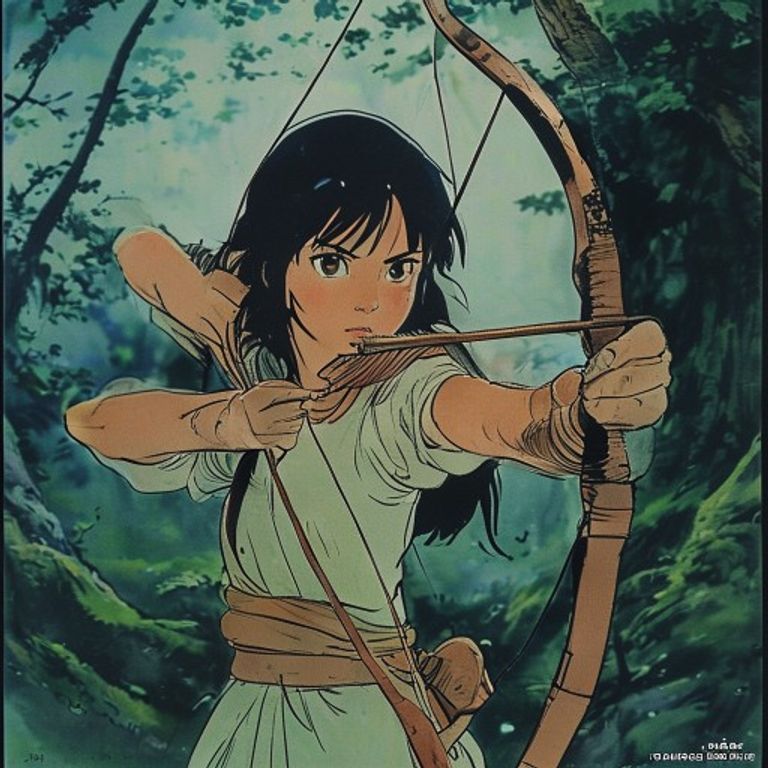
The prompt
Re-render this image as a frame from Studio Ghibli's Princess Mononoke (1997), expressive hand-painted animation direction, verdant wet-on-wet watercolor backgrounds, cel-on-acetate production. Subject in three-quarter angle full-draw with bow, both arms taut, bowstring at the side of the face, eye tracking target off-frame. One arm shows the cursed serpentine mark (writhing dark lines under the skin like animated tendons), the other arm in clean composition. Posture frozen at the precise instant of decision: bowstring at maximum tension, arrow nocked and ready, the entire body composed in the single line of force from target back through arms, torso, planted feet. Background: forest clearing or mountain slope in soft-focus watercolor, deep moss-green and shadow, faint suggestion of mist or smoke, distant tree silhouettes. Lighting: overcast or pre-dawn cool light, no harsh sun, subject lit with overall low-contrast that emphasizes the cursed-arm detail. Cel-animation linework: confident single-weight ink, the cursed arm lines slightly more dense and writhing as deliberate visual disruption against otherwise clean character lines. Mood: decision-without-flinching, the moment the arrow is already loosed mentally even though it has not left the bow, the cursed instrument of judgment, the protagonist who has accepted that he is dying and uses the dying-time to act with precision. Composition leaves negative space along the implied arrow-trajectory line suitable for top-or-bottom caption insertion. No legible text, no studio watermark. Aspect ratio 16:9 or 4:3 matching source. Preserve the subject and composition of the source image exactly, change only the medium and rendering.
What it is doing
Ashitaka is dying. The curse on his arm will kill him. In the time he has left, he chooses precision over panic. The arrow-draw frame is the visual grammar of decision-under-mortality. The cursed arm is the price. The clean release will be the act. Applied to any contemporary subject mid-decision with skin in the game, the register asserts: the dying-time is when precision matters most, and the cost-marker on the body is the proof the decision is serious.
Ways to change it
Pick any of these in the gallery and the choice is added to the prompt you copy.
- Curse-visibility dial: prominent writhing tendons on arm (signature) vs subtle dark mark, barely visible (early-film) vs full-body curse-creep (late-film, terminal)
- Target-direction dial: looking off-frame right (signature) vs looking off-frame down (executing a beast at close range) vs looking off-frame up (a target above)
- Draw-state dial: maximum tension, about to release (signature) vs mid-draw, building tension (preparation) vs post-release, follow-through (aftermath)
- Companion: archer alone in the clearing, no other figures in frame (signature) vs Yakul, the red elk, standing watchful at the frame edge vs San in soft focus far behind, white wolf at her side
Style lineage
Learn the visual culture this draws from: Studio Ghibli / Princess Mononoke (1997).
Related prompts
See all 15 prompts in the Ghibli-Meme grammar