Futurism / Style prompt
Depero Mechanical Figures: Tin-Toy Clockwork
Fortunato Depero's bright mechanical-puppet mode, the figure rebuilt as bolted polygons and gear-wheels.
Customize this prompt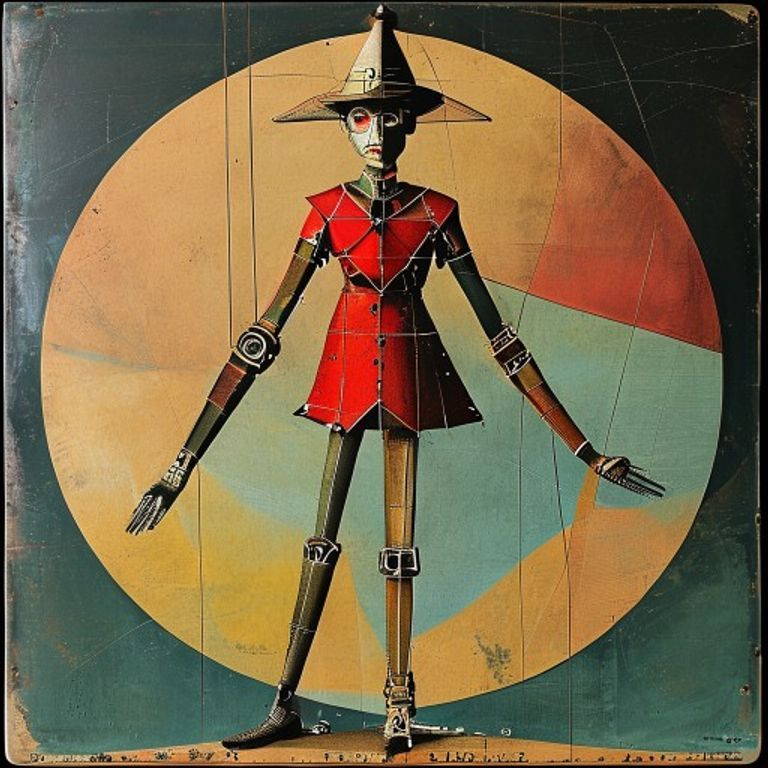
The prompt
Re-render this image in the visual register of Fortunato Depero circa 1917 to 1925, in the manner of his Balli Plastici and Campari illustrations. Rebuild the subject as a mechanical marionette of bolted geometric polygons, cylindrical limbs, conical hats, gear-wheel joints, and rivet-line seams. Flat areas of pure saturated color with crisp black outline, like cut tin-toy plates. Palette of pillar-box red, mustard yellow, viridian green, cobalt blue, ivory white, and matte black, no gradient, no shadow. Background is flat geometric pattern of triangles and arcs. Surface reads as gouache and tempera on board, completely flat. Compositional energy is rotational like a wind-up toy. Strictly no on-canvas text, no legible lettering, no signature, no watermark, no logos. Preserve the subject, pose, and composition of the source image exactly, change only the medium and rendering. Aspect ratio matches source.
What it is doing
Depero is Futurism's friendly face: bright, witty, advertising-ready. He sold Campari for forty years. The cost of that friendliness is total: the human is now an assemblage of replaceable mechanical parts whose charm comes precisely from being parts. Once the figure can be cheerfully disassembled into polygons it can be cheerfully reassigned into a workforce. This is the visual logic of corporate identity. Depero invented the modern logo industry.
Ways to change it
Pick any of these in the gallery and the choice is added to the prompt you copy.
- Part complexity: simple 6 polygons vs medium 20 parts vs dense 50 part bolted assembly
- Palette breadth: primary three only vs classic six vs full carnival ten
- Background: flat solid vs geometric triangles vs repeating pattern
- Outline weight: thin elegant vs medium balanced vs heavy toy-stencil
- Era anchor: 1917 ballet costume vs 1925 corporate poster vs 1930 New York skyscraper period
Style lineage
Learn the visual culture this draws from: The Art Story.
Related prompts
See all 12 prompts in the Futurism grammar