Futurism / Style prompt
Sant'Elia Città Nuova: Megastructure Render
Antonio Sant'Elia's 1914 visionary city, vast setback towers and elevated transit weaving through canyons.
Customize this prompt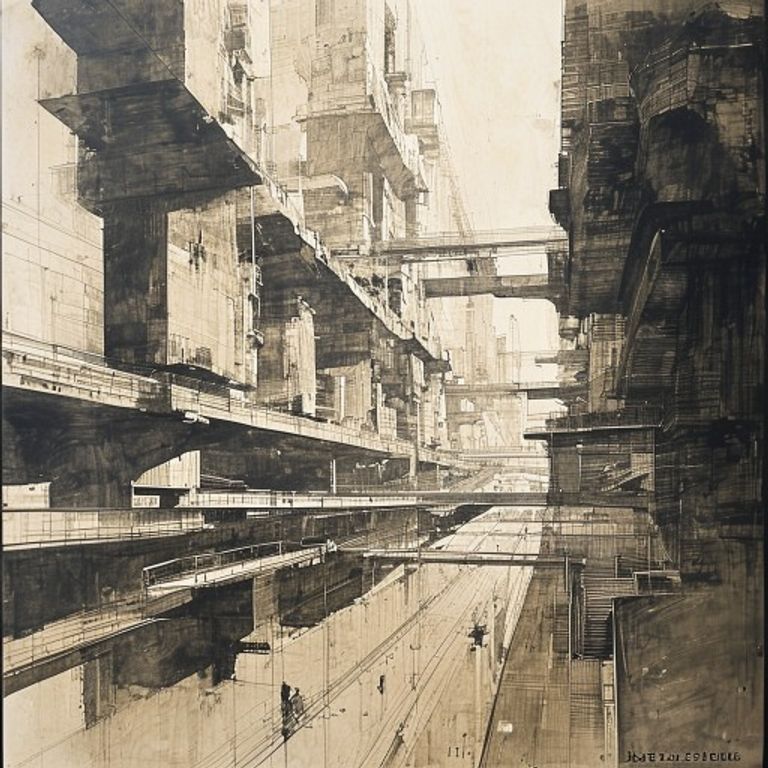
The prompt
Re-render this image in the visual register of Antonio Sant'Elia's Città Nuova drawings circa 1914. Use ink wash and graphite on warm cream paper. Construct the background as a colossal Futurist city of stepped setback towers, exposed elevator shafts, cantilevered terraces, multi-level transit viaducts, suspended pedestrian bridges, and angled buttresses. Sharp linear perspective with dramatic forced foreshortening, low vantage point, towers rising beyond the picture edge. Palette of warm sepia, ink black, graphite grey, and faint architectural blue wash. Era marker is the pre-electric pre-glass concrete-and-steel megastructure imagined just before WWI. Strictly no on-canvas text, no legible lettering, no signature, no watermark, no logos. Preserve the subject, pose, and composition of the source image exactly, change only the medium and rendering. Aspect ratio matches source.
What it is doing
Sant'Elia drew cities humans would inhabit but never own. The Città Nuova is gorgeous because it treats the citizen as a circulation flow through engineered conduits. The thesis is that the modern city should be designed for the movement of bodies through it, not for the lives of bodies in it. Sant'Elia died in WWI before any of it was built, but every postwar megaproject from Brasilia to Pudong inherited his diagram and his blind spot.
Ways to change it
Pick any of these in the gallery and the choice is added to the prompt you copy.
- Tower height: mid-rise 8 stories vs tall 30 stories vs colossal 80 stories piercing sky
- Transit density: single viaduct vs three-level interchange vs dense weaving network
- Vantage: street level looking up vs mid-level oblique vs bird-eye axonometric
- Wash density: light graphite line only vs medium ink wash vs heavy atmospheric tone
- Era anchor: raw concrete towers, exposed elevator shafts, bare steel viaducts, no ornament (signature) vs stepped towers with zigzag Art Deco crowns, chevron bands, fluted piers vs massive symmetrical stone civic blocks, flat colonnades, severe rectangular arches
Style lineage
Learn the visual culture this draws from: Italian Futurist architect (1888–1916).
Related prompts
See all 12 prompts in the Futurism grammar