Fine-Art / Style prompt
Whistler Tonalist Nocturne (Style-Only, Image-Conditioned)
Style register: James McNeill Whistler Nocturne series grammar, 1870s through 1880s, the subject reduced to a narrow tonal range, the picture titled as a "harmony" or "arrangement" because the picture is, finally, about its own tone.
Customize this prompt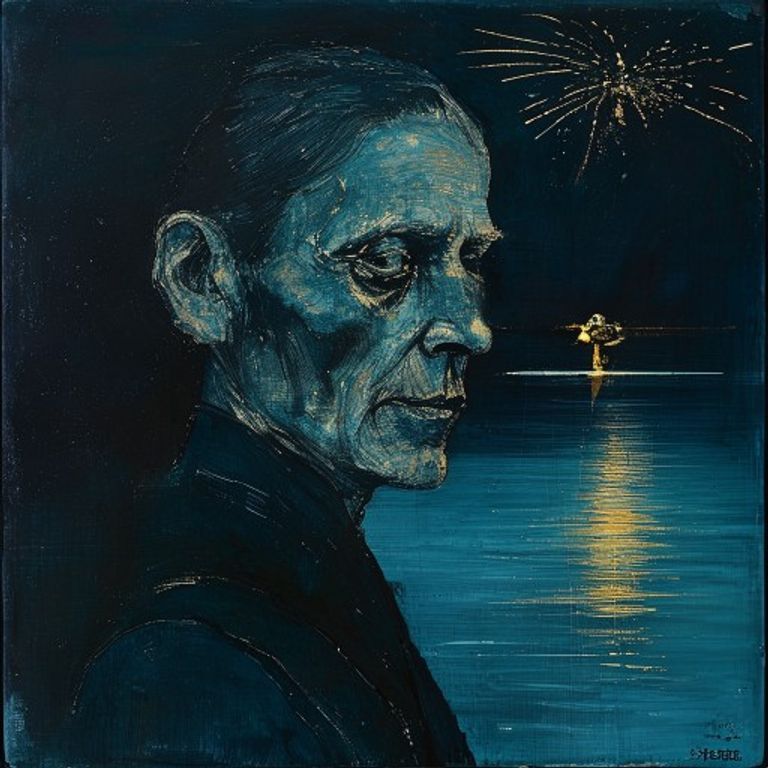
The prompt
Re-render this image as a James McNeill Whistler Nocturne, in the visual register of Nocturne in Black and Gold, Nocturne in Blue and Silver, and Arrangement in Grey and Black. Extreme tonal restriction: the entire picture occupies a narrow band of values within a single hue, typically a deep blue-green dusk, a silver-grey twilight, or a brown-gold riverine nocturne. Paint applied as thin atmospheric washes in liquid oil and turpentine, the surface wiped and re-glazed multiple times, brushwork erased into pure tone. Subject reduced to silhouette and suggestion, no rendered detail, no modeling, no internal description, just the dark mass against the slightly less dark ground. Selective tiny dabs of high-key accent in the deepest darks: a yellow lamp, a spark of gold from a firework, a single white catch on water, distributed sparingly like a musical accent. Composition flat and Japanese-influenced (ukiyo-e), often with a strong off-center vertical or horizontal compositional bar, the influence of Hokusai and Hiroshige absorbed and Westernized. Aspect: contemplative, evening, the senses dialed down to the threshold of perception. Frame implied: thin gold leaf with a Whistler butterfly mark suggested at the corner, do not render the butterfly legibly. No on-canvas text, no signature, no studio watermark. Preserve the subject, pose, and composition of the source image exactly, change only the medium and rendering.
What it is doing
Whistler sued Ruskin in 1878 for calling his Nocturne "a pot of paint flung in the public's face." He won, was awarded one farthing, was bankrupted by the costs. The lawsuit IS the thesis: a picture is an arrangement of tone and color, not a moral instruction. Pay the artist for the arrangement or do not pay him. To apply Whistler is to assert that the contemporary picture has no message, only a key signature.
Ways to change it
Pick any of these in the gallery and the choice is added to the prompt you copy.
- Key: Nocturne in Blue and Silver (signature) vs Nocturne in Black and Gold vs Arrangement in Grey and Black vs Symphony in White
- Subject reduction: silhouette only, no internal detail (signature) vs slight modeling allowed
- Accent dots: 2-4 high-key sparks in deepest dark (signature) vs none, pure tone field vs more accents
- Composition: Japanese off-center vertical bar (signature) vs centered subject vs horizontal band division
- Surface: wiped-and-reglazed thin atmospheric (signature) vs slightly more opaque
- Atmospheric moisture: riverine London fog vs dry evening clarity vs dusk transitioning to night
Style lineage
Learn the visual culture this draws from: American Tonalist painter (1834–1903).
Related prompts
See all 20 prompts in the Fine-Art grammar