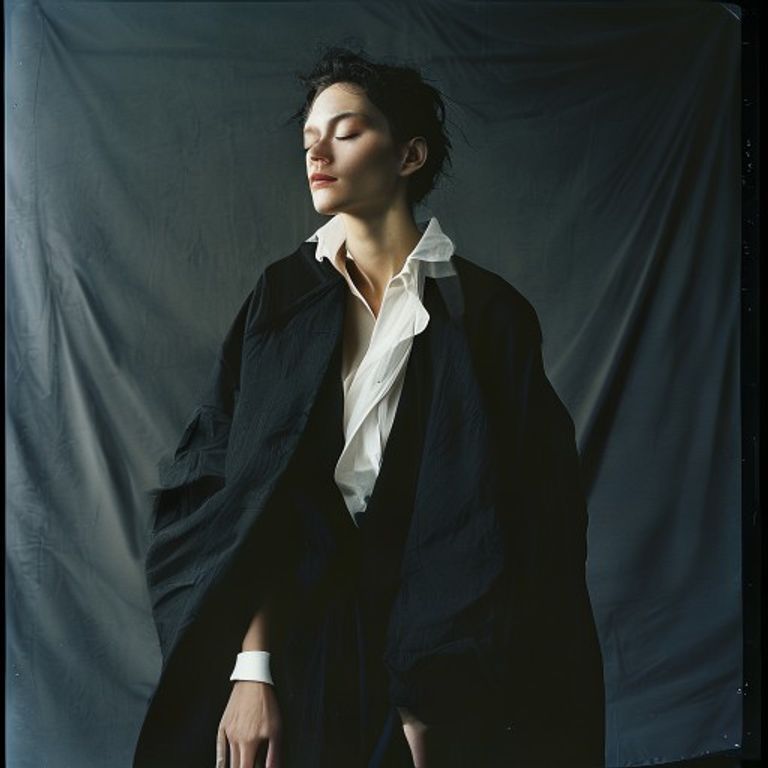
Austere Black-Drape Fashion Editorial with Large-Format Instant-Film Softness
Re-render as an avant-garde black-drape editorial with dreamlike, soft-focus large-format instant-film portraiture: near-monochrome fabric architecture with the body suggested beneath it.
The prompt
Re-render this image as a fashion editorial photograph of avant-garde sculptural black draping, with dreamlike soft-focus fashion portraiture and experimental high contrast, exposed on large-format 8x10 Polaroid Type 55 (or rendered to feel like that medium): soft slight-bloom around highlights, gentle tonal compression, deep but not crushed blacks, the texture of the Polaroid emulsion visible in shadow areas. Wardrobe styling cue: voluminous black drape and asymmetric tailoring (oversized silhouette, asymmetric hem, raw exposed seam, dropped shoulder, the fabric mostly black or charcoal with occasional white shirt collar peeking, sometimes a deep dye-fade gray), the garment volume larger than the body inside it, the body suggested rather than displayed. Setting: minimal, often pure black or deep gray seamless backdrop, occasionally a stark white wall for inversion contrast, or an empty wooden-floor gallery space, never a busy environment. Lighting: single large soft source (5x7 foot diffusion frame from camera-right or upper) producing wrap-around modeling on the garment folds, with very dim ambient fill, the figure emerging from near-black background through tonal gradation on the fabric and skin, no rim light, no specular highlight. Subject: posture composed and still, often eyes closed or looking away from camera, expression contained and serious, the model functioning as fabric-armature rather than as personality, hands often partially obscured by garment volume. Color: near-monochrome, the rare allowed accents being skin tone (often pale, contained against the black) and a single white element (shirt collar, paper, glove), the entire frame trending toward grayscale even when shot in color. Composition: medium full-figure or three-quarter, generous negative space at top, the figure occupying lower two-thirds of frame, garment-silhouette doing the design work. Mood: austere, monastic, the refusal of color and ornament as a positive aesthetic position, the Japanese-avant-garde rebuke to European fashion-spectacle. Forbid: any beauty lighting that flatters skin, any glossy retouched surface, any color competing with the black, any visible logo or brand text (no hallucinated lettering), any cluttered background, any watermark or signature. Preserve the subject, pose, and composition of the source image exactly, change only the medium and rendering.
What it is doing
Black draping can feel "modest and arrogant at the same time" and refuse to perform for the viewer. The volume of the garments is architecture around the body rather than display of the body. Re-rendering in this register asserts that the refusal of color is itself the chromatic statement, and that restraint can do what saturation cannot.
Tuning knobs
- Backdrop dial: `pure black seamless` vs `deep gray graduated` vs `inverted white wall` vs `empty wooden gallery floor`
- Light dial: `single 5x7 soft from right` vs `single soft from upper directly above` vs `single soft from far behind diffuse (silhouette-leaning)`
- Subject dial: `eyes closed contained` vs `looking away in profile` vs `direct serious gaze` vs `partial face obscured by garment`
- Color dial: `pure monochrome black-and-white` vs `near-monochrome with skin warmth` vs `single white-collar accent` vs `single deep-red accent (rare exception)`
Style lineage
Learn the visual culture this draws from: Wikipedia.
Related prompts
See all 7 prompts in the Fashion-Editorial grammar · Open in the gallery
Get the free sample. The intro plus the first three chapters of The Liberation Engine, delivered as a PDF. The full book and the complete 642-prompt method are the paid edition.