Expressionism / Style prompt
Beckmann Triptych Allegory
Compressed claustrophobic frame, heavy black contour, jewel-tone interior, figures jammed together in allegorical theater.
Customize this prompt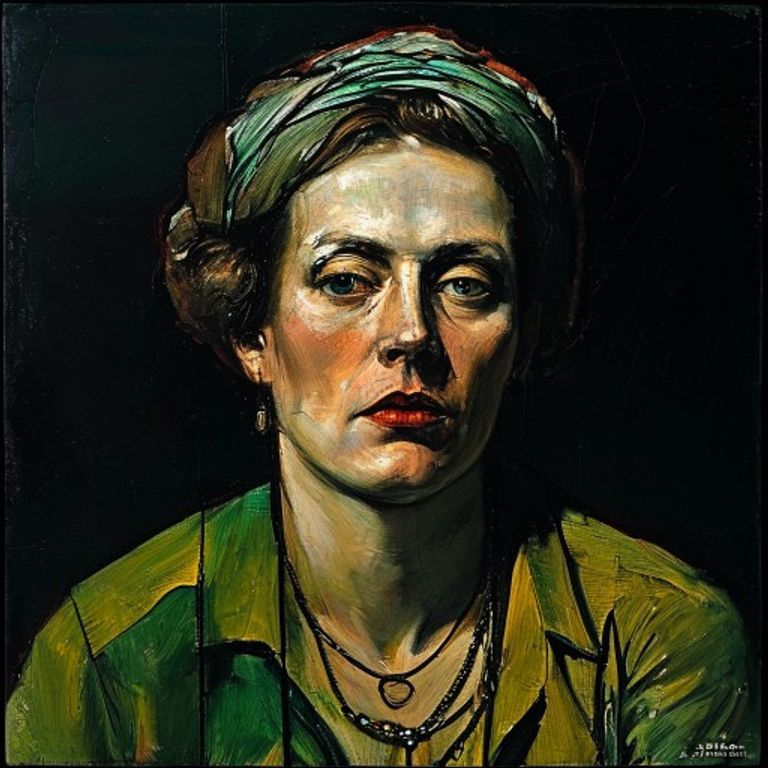
The prompt
Re-render this image in the visual register of a Max Beckmann 1925 to 1937 painting, as if oil on canvas with the heavy black outline and compressed claustrophobic framing of his Frankfurt and Berlin period. Bound every form in a thick decisive black contour like a leaded stained-glass cell. Compress the picture-plane so figures and props jam against the foreground with almost no breathing room, foreshortening exaggerated to push everything forward. Surface is dense oil with visible scumbling, a slight gloss in dark passages and matte chalky color in midtones. Palette: jewel-tone interior with deep emerald, oxblood red, mustard, prussian blue, lemon yellow, ivory, all keyed up to high saturation against ink-black contour. Mood: cabaret-theatrical allegory of a civilization in moral free fall, sensual and ugly at once, the lighting of a private club that also resembles the lighting of an interrogation room. Strictly no on-canvas text, no legible lettering, no signature, no watermark, no logos. Preserve the subject, pose, and composition of the source image exactly, change only the medium and rendering. Aspect ratio matches source.
What it is doing
Beckmann's contour line is iron because the Weimar moment required iron to hold the figures inside the frame. The political claim is that the allegory is not metaphor; the room is literal. The torture room and the cabaret share a switchboard. The painter knew the addresses.
Ways to change it
Pick any of these in the gallery and the choice is added to the prompt you copy.
- Contour weight: medium black line vs Beckmann's full lead
- Compression: some depth vs full claustrophobic flatten
- Saturation: muted jewel vs full carnival
- Figure count: single vs jammed crowd
- Theatrical staging: naturalistic vs allegorical tableau
Style lineage
Learn the visual culture this draws from: The Art Story.
Related prompts
See all 6 prompts in the Expressionism grammar
Read the full free book. All thirty-six chapters and the companion 657-prompt image library are free.