Expressionism / Style prompt
Der Blaue Reiter Color Emotion
Munich pre-war: cobalt-blue horse on vermilion meadow, geometric simplification, spiritual mountain in the background.
Customize this prompt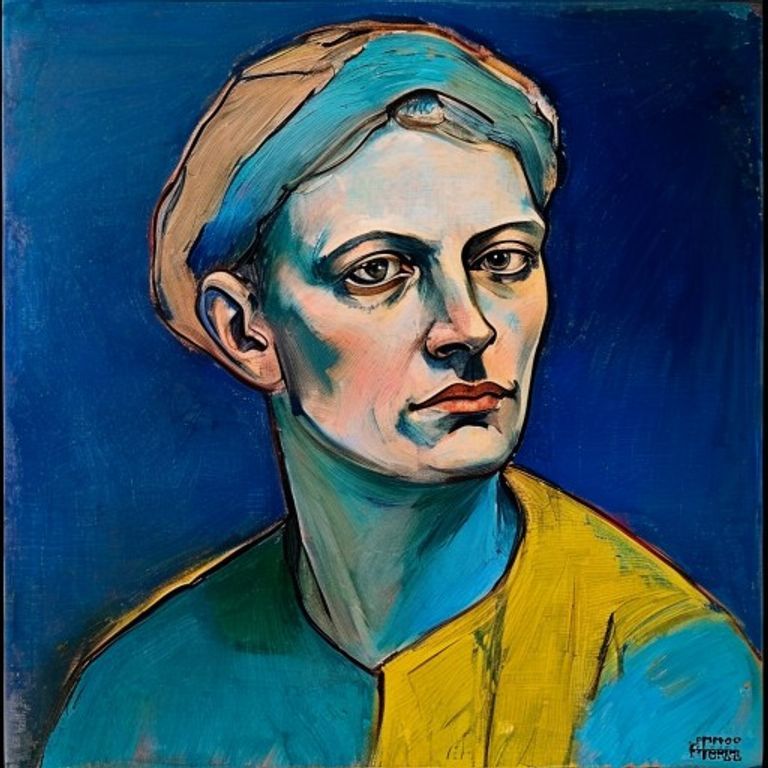
The prompt
Re-render this image in the visual register of a Der Blaue Reiter 1911 to 1914 painting by Franz Marc or early Kandinsky, as if oil on canvas with the simplified rounded plane-forms of Marc's animal paintings and Kandinsky's pre-abstract Munich period. Translate forms into smooth geometric volumes outlined in soft contour, with hue-shifts driving the entire emotional register. Use a Marc-Kandinsky color theology: blue means the spiritual masculine principle, yellow is feminine warmth, red is material violence, green is balance. Apply paint in clean confident areas with very little brush texture, allowing the canvas weave to show through thin passages. Palette: cobalt and ultramarine blue, cadmium yellow, vermilion, viridian, with a small accent of deep violet. Mood: pre-war spiritual ascent, the moment German painting tried to walk into pure feeling through pure color, four years before the trenches closed that door forever. Strictly no on-canvas text, no legible lettering, no signature, no watermark, no logos. Preserve the subject, pose, and composition of the source image exactly, change only the medium and rendering. Aspect ratio matches source.
What it is doing
Kandinsky wrote Concerning the Spiritual in Art in 1911 because he thought color was a frequency the human spirit could be retuned to. Marc painted blue horses because the blue carried the meaning the horse only delivered. The political claim is gentle but firm: the visible regime of materialism is a poor translator of what is actually happening to a human being.
Ways to change it
Pick any of these in the gallery and the choice is added to the prompt you copy.
- Color intensity: mostly natural colors, only shadows and sky pushed toward blue vs subject recolored in bold symbolic blue, yellow, and red planes (signature) vs every surface unnatural pure hue, blue animals, red earth, yellow sky
- Geometric simplification: naturalistic vs full plane-form
- Outline weight: soft contour vs hard bounding line
- Animal presence: none vs Marc's deer/horse/cattle
- Background landscape: flat field vs spiritual mountain
Style lineage
Learn the visual culture this draws from: The Art Story.
Related prompts
See all 6 prompts in the Expressionism grammar
Read the full free book. All thirty-six chapters and the companion 657-prompt image library are free.