De-Stijl / Style prompt
Huszar Mechanical Primary Composition (Style-Only, Image-Conditioned)
Style register: Vilmos Huszar 1917 to 1923 De Stijl mechanical-tile and applied-graphic grammar, modular interlocking primary-color tiles tessellated across the canvas, the orthogonal grid implied through tile edges rather than drawn black lines.
Customize this prompt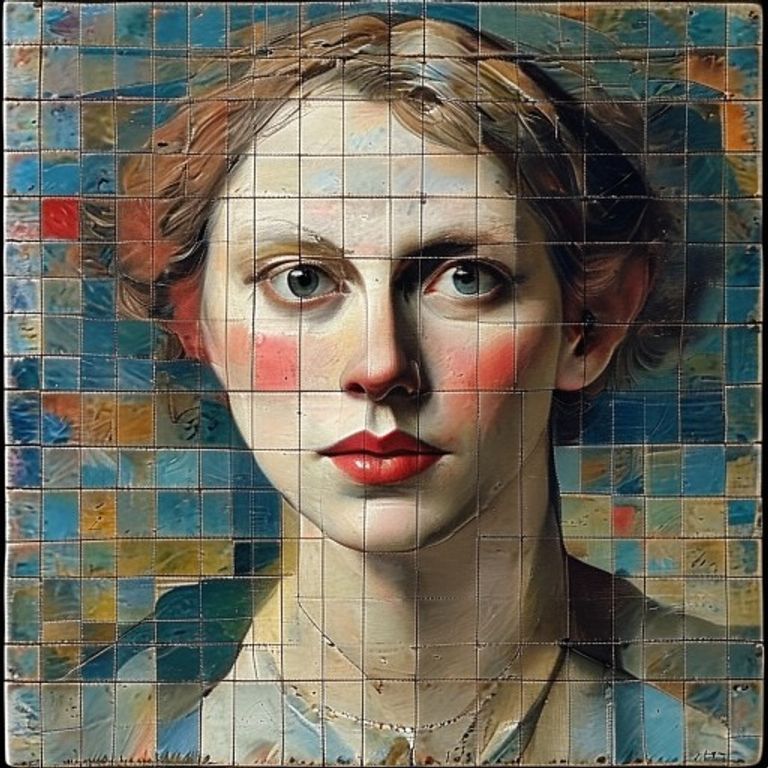
The prompt
Re-render this image in the visual register of a Vilmos Huszar De Stijl tile-composition or applied graphic, circa 1917 to 1923. Treat the picture surface as a tessellated field of small interlocking rectangular tiles, each tile a single flat unmodulated color in the strict De Stijl palette (cadmium red, chrome yellow, ultramarine blue, chalk white, lampblack). The underlying subject reads as a denser concentration or chromatic shift inside the tile field, never as a separately drawn figure. Tiles vary in size and proportion but always interlock at right angles, no diagonals, no gaps. The orthogonal grid is implied through the edges where tiles meet, never drawn as a separate black line on top. Faint mechanical line at each tile boundary as if printed lithographically. Color distribution favors white and black with primaries used as accents in 15 to 25 percent of tiles. Mood: modular, repeatable, the doctrine reduced to a pattern-tile that could in principle paper a wall or print an endpaper. The applied-art face of De Stijl, where the painting becomes the wallpaper. Strictly no on-canvas text, no legible lettering, no signature, no watermark, no logos. Preserve the subject, pose, and composition of the source image exactly, change only the medium and rendering. Aspect ratio matches source.
What it is doing
Huszar is De Stijl's applied-art conscience. Where Mondrian made paintings as scripture, Huszar made stained glass, interior schemes, magazine covers, and tile patterns from the same primary-color doctrine. The implication, often soft-pedalled by art history, is that the movement was never just easel art. It was always trying to colonize the everyday object. The tile composition is the easiest unit of that colonization. Hang one in a room and the rest of the room has to apologize for itself. That is the point.
Ways to change it
Pick any of these in the gallery and the choice is added to the prompt you copy.
- Tile size variance: mixed small to medium (signature) vs uniform small grid vs mixed including large blocks
- Primary ratio: 15 to 25 percent tiles colored (signature) vs single primary accent vs dense 50 percent primary
- Edge treatment: faint mechanical line at boundaries (signature) vs no line, pure color edge vs heavy drawn black line
- Composition focus: subject as chromatic shift in field (signature) vs subject as central concentration vs subject fully dissolved
- Print quality: lithographic flat (signature) vs slightly painterly vs digital razor
Style lineage
Learn the visual culture this draws from: Museo Thyssen.
Related prompts
See all 6 prompts in the De-Stijl grammar