Comic-Book / Style prompt
Manga Screentone Speedlines
Re-render as manga: dramatic screentone patterns, velocity lines suggesting motion, pen-and-brush linework, tonal density for drama not realism.
Customize this prompt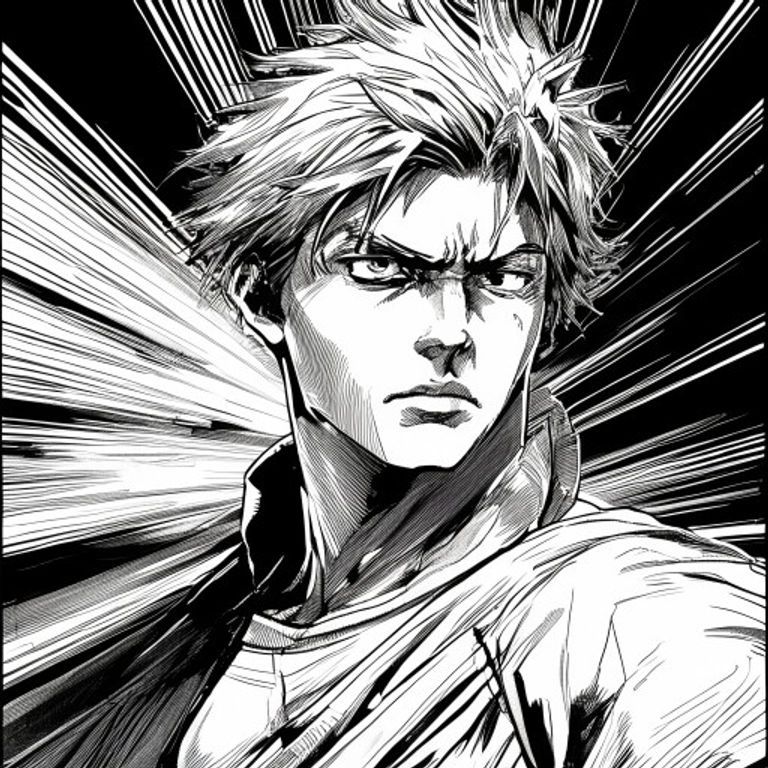
The prompt
Re-render this image as a manga panel page in the tradition of Japanese shonen (action) or seinen (adult) manga, executed in pen and brush with extensive use of screentone halftone patterns and dramatic motion-rendering techniques. Linework: brush and pen ink with single-weight or varying-weight contour lines defining form, interior detail through line-weight variation and selective hatching (not cross-hatch but parallel-line patterns), dynamic exaggerated anatomy and proportions suggesting action and energy rather than anatomical realism. Figure rendering: bold graphic line, musculature suggested through line-weight and shading, faces expressive through feature-placement and eye-emphasis. Screentone application: extensive use of adhesive or digital half-tone screentone patterns (regular dot or line-pattern screens) to represent shadow, fabric texture, hair volume, and depth, screentone tone-stepping from very light to very dark (zero, 10%, 30%, 50%, 70%, 90%) creating the characteristic manga tonal range. Speedlines: dynamic radiating lines emanating from the figure or through the composition suggesting motion, direction, kinetic energy, or dramatic emphasis, often converging toward or away from a point, the speedlines are not realistic but syntactical markers of action and energy. Background: simplified or atmospheric, often with dramatic geometric abstraction suggesting environment without detailed rendering, sometimes reduced to screentone gradients or directional line-hatching. Composition: dynamic and often diagonal, the subject positioned as the center of kinetic energy, poses suggesting motion mid-action. Color: black, white, and grayscale only (screentone is monochrome), no color unless specified by user. Mood: dramatic, kinetic, the form language is the syntax of speed and action and emotional intensity. Forbid: any speech bubble or onomatopoeia text on canvas (those are added separately), any soft airbrushed rendering, any photoreal detail, watermark. Preserve the subject, pose, and composition of the source image exactly, change only the medium and rendering.
What it is doing
Manga screentone and speedlines are not decorative; they are syntactical units in a visual language. Screentone is the carrier of tonal information on the printed page when halftone process-color is unavailable or rejected for artistic effect. Speedlines are the visual encoding of kinetic energy and narrative momentum. Together, they form a complete grammar that is uniquely Japanese and uniquely comic. Re-rendering in this register asserts that manga visual syntax is a language as complex as any written language.
Ways to change it
Pick any of these in the gallery and the choice is added to the prompt you copy.
- Screentone-density dial: light accent only vs moderate tonal range vs extreme high-contrast density vs full range from white to pure-black
- Speedline-intensity dial: subtle directional accent vs moderate converging-lines dramatic vs extreme explosive multi-direction velocity field vs minimal motion-suggestion
- Line-weight-variation dial: consistent single-weight vs moderate variation with form vs dramatic exaggerated weight-stepping vs calligraphic brush-variation
- Proportion-exaggeration dial: anatomically plausible vs stylized manga-proportions vs extreme action-pose distortion vs chibi or super-deformed
- Background-treatment dial: detailed environment with screentone vs simplified geometric abstraction vs gradient-field minimalism vs pure white or atmospheric
Related prompts
See all 16 prompts in the Comic-Book grammar