Comic-Book / Style prompt
Kirby Krackle Cosmic Power
Re-render as a pure Kirby power-burst: subject surrounded by dense Kirby-crackle dot-field, energy made visible through abstract geometry and pattern, not glow.
Customize this prompt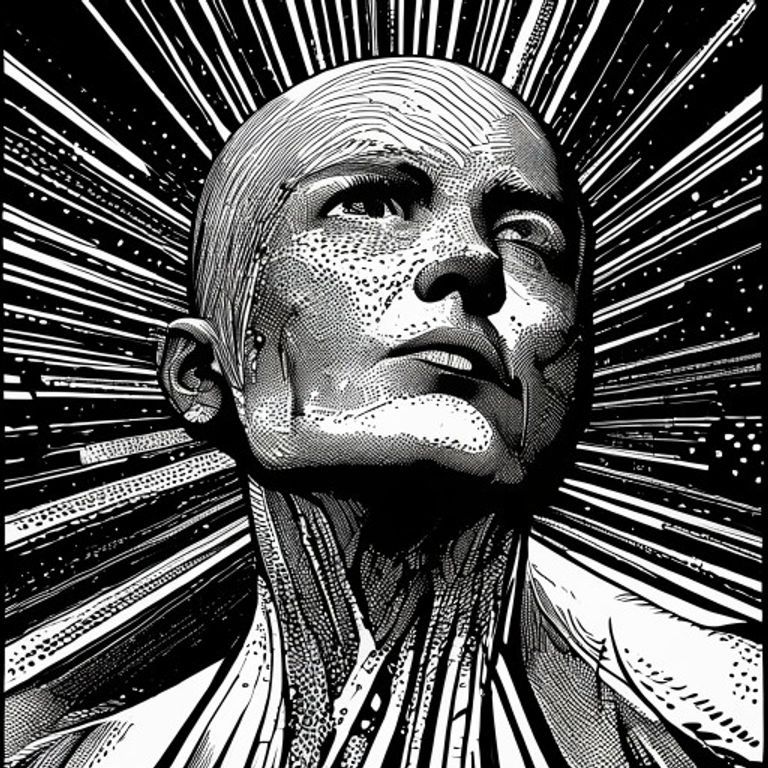
The prompt
Re-render this image as a comic book panel or splash in the manner of Jack Kirby's New Gods and Eternals cosmic-power sequences, executed in heavy black ink with crisp contours and deep blacks, colored in flat four-color newsprint separation palette (pure cyan, magenta, yellow, black with minimal overlay tints). Subject: the source image rendered in Kirby's blocky faceted figure-construction with square fingertips, broad shoulders forming geometric planes, heavy contour lines defining form. Surrounding the subject: an intense field of "Kirby krackle" rendered as dense patterns of black dots radiating outward from the figure, the dots serving as the visual grammar of cosmic force, power-field, or magical effect, the dot-pattern density increasing toward the figure and fading to white at the outer edges. Geometric energy forms: hard-edged angular energy bursts or force-vectors extending from the figure's position, not soft glowing forms but faceted geometric shapes in stark black and white or flat color tones. Background: cosmic Kirby-machinery or alien landscape (hexagonal terrain, curved corridors with architectural facets, fractal mineral formations) rendered in flat colors with minimal detail, the machinery serving as evidence of the scale the figure inhabits. Composition: figure dynamic and low-angle, the pose suggesting the moment of power-release or cosmic declaration, one arm extended or fist forward. Linework: single-weight thick black contour line, dense parallel hatching only in deep shadow recess areas, no fine cross-hatch, no rendering subtlety, the printed page as architectural statement. No speech bubble, no caption, no sound effect text on canvas, no watermark. Forbid: airbrushed digital rendering, photoreal skin, modern CGI glow effect, any soft lighting. Preserve the subject, pose, and composition of the source image exactly, change only the medium and rendering.
What it is doing
Kirby invented a visual language for abstract force. The krackle is not decoration; it is the representation of cosmic energy made manifest through pure graphic pattern. Where modern computer graphics use glow and soft-light to suggest power, Kirby used the dot-field, which is far more legible and far more honest about what comics are: ink-pattern on paper converted to meaning in the viewer's eye.
Ways to change it
Pick any of these in the gallery and the choice is added to the prompt you copy.
- Krackle-intensity dial: light accent around hands vs medium field surrounding figure vs dense absolute immersion, figure nearly obscured
- Krackle-pattern dial: uniform dot-density vs radial emanation increasing toward center vs irregular organic crackle resembling fractured surface
- Background-machinery dial: minimal machinery subtle accent vs moderate faceted architecture vs dense complex Kirby-tech dominating
- Energy-bolt style: geometric angular faces vs organic amorphous shapes vs hybrid angular-to-organic transitions
- Composition dial: figure centered in field vs off-center dynamic motion vs figure as edge-element with crackle field extending off-frame
Style lineage
Learn the visual culture this draws from: Medium.
Related prompts
See all 16 prompts in the Comic-Book grammar