Frank Miller Sin-City High-Contrast Noir
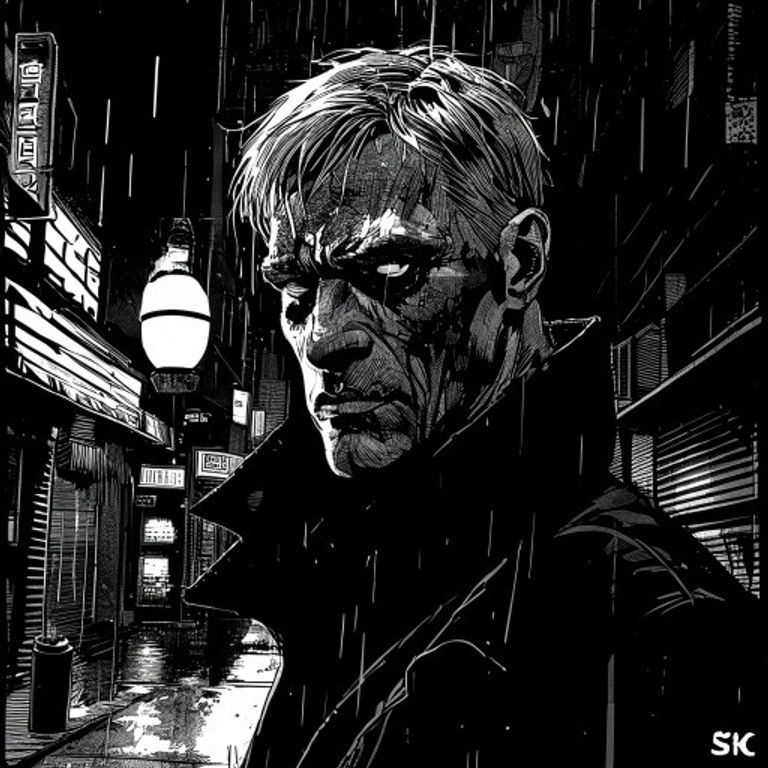
Re-render as a Sin City page: pure black and white silhouette, no halftones, no gray, occasional single-spot-color accent (red, yellow, blue) for moral weight.
The prompt
Re-render this image as a comic book panel in the manner of Frank Miller's "Sin City" series (1991 onward), executed in pure black and white with no gray tones, no halftone screens, no cross-hatch shading: every value collapses either to solid black ink or to bare white paper, with the figure-ground separation carried entirely by silhouette logic. Linework: most contour lines are eliminated and the form is described by negative-space cut-outs, white shapes emerging from black masses or black masses cutting into white expanses. Where line exists it is brush-inked thick and confident, no thin pen-line subtlety. Lighting: extreme noir, the figure half-swallowed by black shadow with only a few key highlights describing form (cheekbone, edge of jaw, edge of fabric, glint of eye), or the figure rendered as pure black silhouette against a white field, or in reverse as a white figure against a fully black field. Setting: rain-wet city street, alley with streetlamp glow, neon-sign reflection on wet asphalt, interior bar with single overhead bulb, fire-escape against night sky. Composition: high-contrast graphic design, the panel reading first as abstract black-and-white shape relationship and only second as representational scene. Spot color: at most one single color element (red blood, yellow eyes or yellow car, blue dress, green absinthe, white only-the-eyes), kept pure flat unmodulated, no gradient, no shading, used sparingly to carry moral or narrative weight. Mood: pulp noir, hard-boiled, the world as binary, no soft middle ground. Forbid: any gray-scale rendering, any halftone screen, any speech bubble or sound effect or caption text on canvas, any photoreal rendering, any modern digital airbrush, any watermark. Preserve the subject, pose, and composition of the source image exactly, change only the medium and rendering.
What it is doing
Miller's Sin City eliminates gray and forces every value to commit. This is a graphic choice that doubles as a moral one: in a moral universe of compromise and shading, the comic frame insists everything is either light or shadow. Re-rendering in this register strips a scene to its silhouette truth.
Tuning knobs
- Inversion dial: `black figure on white field` vs `white figure on black field` vs `figure split half-and-half by light edge`
- Spot-color dial: `pure black and white only (no spot)` vs `single red accent (blood, dress, lips)` vs `single yellow accent (Marv-style)` vs `single blue accent`
- Setting dial: `rain-wet street with streetlamp` vs `interior bar single bulb` vs `rooftop against night sky` vs `confessional booth backlit`
- Detail dial: `near-abstract silhouette` vs `medium with key highlights` vs `more detailed (less Miller, more Toth or Eisner)`
Style lineage
Learn the visual culture this draws from: Pipeline Comics.
Related prompts
See all 16 prompts in the Comic-Book grammar · Open in the gallery
Get the free sample. The intro plus the first three chapters of The Liberation Engine, delivered as a PDF. The full book and the complete 557-prompt method are the paid edition.