Comic-Book / Style prompt
Jack Kirby Cosmic Crackle Bombast
Re-render as a King Kirby double-page splash: faceted machinery, blocky musculature, Kirby-crackle dot energy, heavy crisp contour inks.
Customize this prompt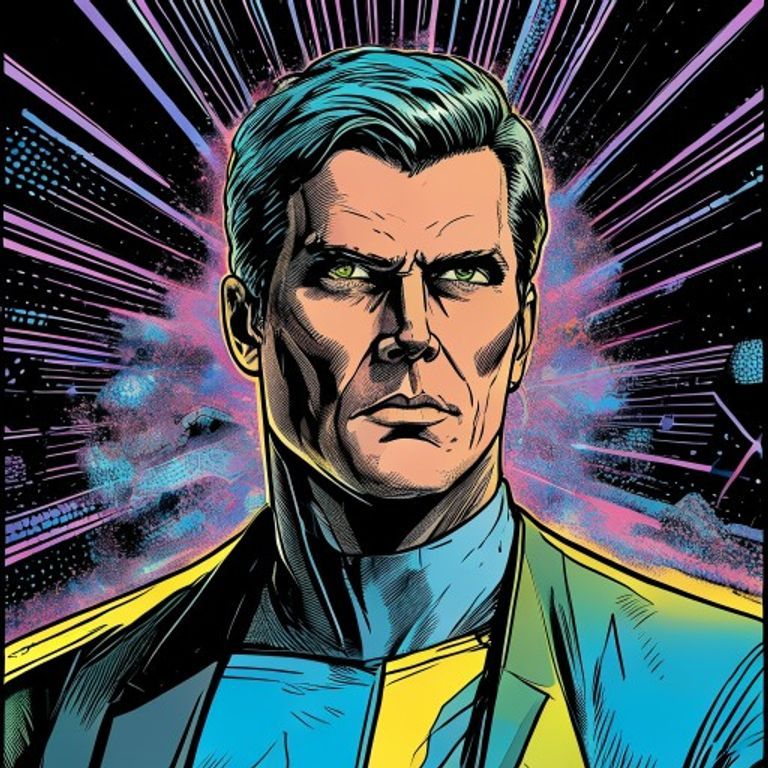
The prompt
Re-render this image as a comic book panel or splash page in the manner of Jack "King" Kirby in his 1970s peak (Fourth World, New Gods, Eternals, late Fantastic Four), inked in a heavy bold tradition with crisp contours and deep blacks, colored in flat four-color separation values (the original printed Marvel/DC newsprint palette of pure cyan, magenta, yellow, black with limited overlay tints producing a small fixed color set). Linework: thick black single-weight contour lines defining figures and machinery, with dense parallel hatching only in deep-shadow recess areas, no fine cross-hatch, no rendering subtlety. Figure construction: blocky faceted musculature with the characteristic Kirby "square fingertips" on hands, broad chest and shoulders forming geometric planes, thighs as cylinders, faces with strong cheekbone-to-jaw angles, eyes often inset with single shadow. Background: cosmic Kirby-tech machinery (curved corridors, faceted control panels, geometric energy conduits) or alien landscape (jagged mountain forms, fractal mineral structures, hexagonal terrain plates). Energy effects: the "Kirby krackle" (dense black dot patterns surrounding energy bursts, weapons, cosmic figures, indicating fields of force), plus jagged geometric energy bolts (not glowing, not soft, hard-edged shapes). Color: limited palette dominated by pure primaries with one secondary accent, flat fill, no gradients, no airbrush, the printed-newsprint look. Composition: low-angle hero shot, double-page splash with figure in dynamic mid-pose (fist outward, foot planted on architecture, cape mid-flare), background machinery converging toward figure as visual emphasis. Mood: cosmic bombast, mythological scale, the printed page as Sistine Chapel ceiling. Forbid: any speech bubbles or captions or sound-effect text on canvas (those are added separately), any modern airbrushed digital rendering, any photoreal skin, any AI-compositing artifact, any watermark or signature in image. Preserve the subject, pose, and composition of the source image exactly, change only the medium and rendering.
What it is doing
Kirby invented the visual grammar that lets a comic page convey cosmic scale in flat ink. The crackle, the blocky figure, the faceted machinery: each is a rejection of soft realism in favor of myth-glyph. Re-rendering in this register asserts that power is a geometric fact, not a glow effect, and that the printed page outranks the lit screen.
Ways to change it
Pick any of these in the gallery and the choice is added to the prompt you copy.
- Inker dial: heavy crisp contour ink vs smooth slick contour ink vs thin loose ink (least aligned with blocky geometry)
- Era dial: late-1960s Fantastic Four vs 1970s Fourth World peak vs early-1980s Pacific Comics return
- Krackle density dial: light krackle accent around hands only vs medium field around figure vs full cosmic-immersion all background
- Composition dial: single-panel hero pose vs double-page splash with depth recession vs nine-panel grid with one dominant
Style lineage
Learn the visual culture this draws from: 13th Dimension.
Related prompts
See all 16 prompts in the Comic-Book grammar
Read the full free book. All thirty-six chapters and the companion 657-prompt image library are free.