Coach / Style prompt
Coach Olympic Lifting Platform Spotter
A weightlifting coach standing close behind the athlete on the platform, hands hovering at the bar's catch-path, watching a maximum-attempt clean-and-jerk or snatch. The permission-to-attempt-maximum register.
Customize this prompt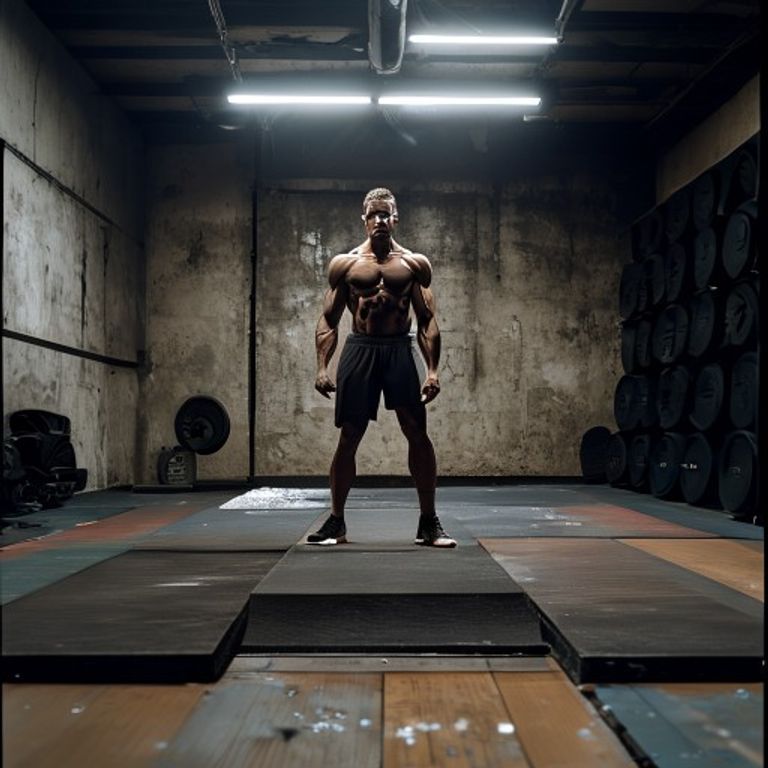
The prompt
Re-render this image as a documentary-style photograph in the register of a serious Olympic-weightlifting training gym or competition warm-up room, dedicated lifting-platform area, harsh overhead lighting. Setting: rubber-mat or hardwood-platform lifting surface (the canonical raised wooden platform with the surrounding rubber drop-area for plate-impact), a barbell loaded with multiple competition-style bumper-plates on each side (plates rendered as solid color-banded discs with no legible weight-numerals, just the visible plate-stack indicating heavy loading), a chalk-bowl visible at one corner of the platform with white chalk-dust dusting the platform surface and the surrounding floor. Walls of the room industrial: bare concrete or painted cinder-block, possibly with a wall-mirror for form-check at one side and racks of additional bumper-plates and barbells visible at the far wall. Ceiling-mounted high-intensity overhead lighting producing strong direct top-light. Subject (the coach, the spotter) positioned standing close behind and slightly to the side of the lifting athlete (the athlete is the source-image subject, preserved exactly), body angled in a stable athletic stance with knees slightly bent and weight forward, hands held up at chest-or-shoulder height with palms-open and fingers spread, hovering just outside the catch-path of the barbell without making contact (the no-touch hover is the diagnostic of competent spotting: present, not interfering). Coach gaze: locked-in on the barbell and the athlete's body-position, reading the lift in real time, ready to step in if the bar travels-back or if the athlete loses position, but not premature. Coach attire: simple athletic-training-coach polo-shirt or fitted t-shirt in muted colors, athletic shorts or training-pants, well-worn weightlifting shoes (the coach is dressed to step onto the platform at any second), no headset or whistle (this is the lifting-room register, not the team-sport register). Visible peripheral: a single second coach or training partner at the corner of the platform with a stopwatch or a phone recording the lift, the suggestion that the lift is being witnessed and timed for record. Lighting: hard top-light producing strong directional shadows under the barbell and under the athlete's body, the coach lit the same as the athlete (no heroic separation), the platform surface highlighted by the direct top-light. Rendering: documentary photo realism, neutral-to-slightly-cool color temperature, mid-grain film texture, sharp focus on the coach and the barbell, with the athlete in equally-sharp focus, no motion blur (this is the held-tension moment, not the explosive moment). Color palette: industrial-gray and rubber-black dominant, the bumper-plate color-bands as the only saturated accent, naturalistic skin tones, no color treatment. Mood: the permission-to-attempt-the-maximum register where the spotter's presence is the entire reason the lifter is willing to load the bar at this weight, the Wingate-cadre mode applied to one-on-one strength-training where the cadre's presence creates the psychological-safety to commit fully to a lift that the lifter would not attempt alone, the spotter does not lift the bar but the spotter makes the attempt possible. Composition leaves the upper or side wall area open for caption insertion. No legible text on weight-plates or apparel, no real numerals on plates or competition-board, no facility-name visible, no logo, no watermark. Aspect ratio matching source. Preserve the subject, pose, and composition of the source image exactly, change only the medium and rendering.
What it is doing
The spotter on a maximum-attempt lifting platform is not lifting the bar. The spotter is providing the psychological permission for the lifter to commit to a weight the lifter would not load alone. The register encodes the Wingate-cadre mode in its most-intimate one-on-one form: the cadre's presence-without-interference is itself the load-bearing variable, because the maximum-attempt requires the lifter to commit knowing that if the lift fails the failure will not be catastrophic. Take the spotter away and the lifter loads the bar to a sub-maximum weight, attempts the lift in safe mode, and never finds out what their actual ceiling is. The spotter is the permission-to-find-the-ceiling. Applied to any subject in a one-on-one mentor-or-witness role where the mentor's presence enables the protege to commit to higher-stakes attempts (research advisors, surgical-residency attending physicians, executive coaches, sponsors in recovery), the frame asserts that the spotter does not do the work, the spotter enables the work to be attempted at maximum.
Ways to change it
Pick any of these in the gallery and the choice is added to the prompt you copy.
- Spotter-distance dial: close-behind hands-hovering (signature competent-spotting) vs medium-distance one-arm-extended (warm-up sets) vs arm-around-shoulder support after a failed attempt (post-fail register)
- Lift-phase implied dial: pre-lift setup, athlete bent over the bar, spotter behind (signature anticipation) vs mid-clean catch position, spotter alert (peak action) vs overhead-jerk lockout, spotter hands raised (climactic completion)
- Plate-loading dial: competition-style bumper-plates stacked heavy (signature maximum-attempt) vs mixed iron-plates and bumpers (training-gym register) vs single heavy-plate per side (warm-up or strength-only)
- Witness-context dial: single second coach with stopwatch (signature) vs no other witnesses, just the spotter-athlete pair (austere-intimate) vs multiple training-partners watching from the periphery (group-witnessed)
- Apparel dial: simple training-polo (signature American gym) vs national-team warm-up tracksuit (international-elite) vs bodybuilder-aesthetic tank-top (commercial-gym, less serious)
Related prompts
See all 18 prompts in the Coach grammar