Coach / Style prompt
Coach Film Study Projector Dark Room
A coach seated in a darkened film-study room, projector-beam illuminating the frame, eyes locked on game-tape with a remote in hand. The tape-room real-game register.
Customize this prompt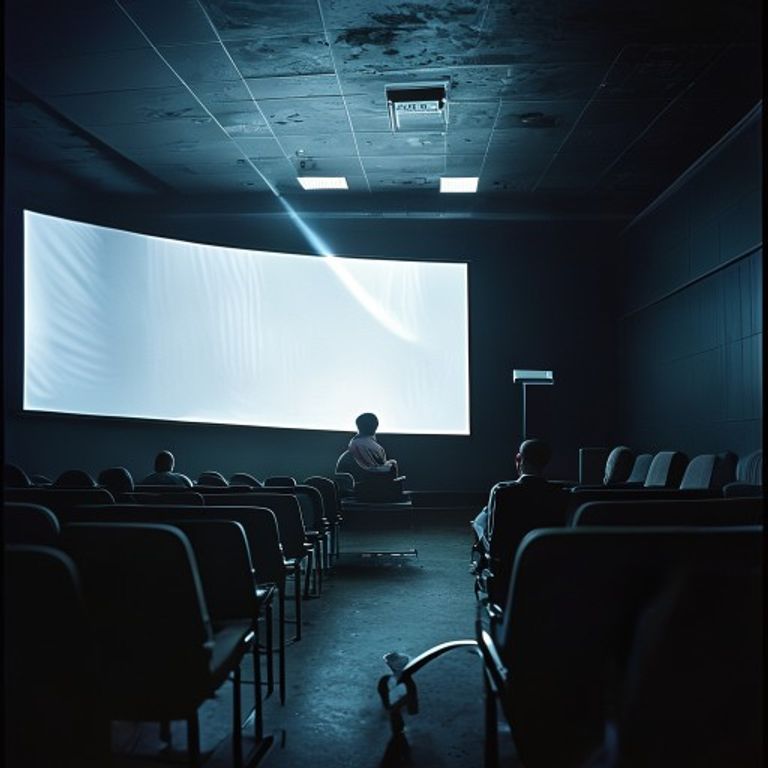
The prompt
Re-render this image as a documentary-style photograph in the register of an American football or basketball coaching-staff film-study room, late evening or off-hours, lights off except for the projector-beam. Setting: enclosed institutional meeting room with a roll-down or wall-mounted projection screen at the front (or a large wall-mounted display), rows of meeting-room chairs or a small conference-table with chairs around it (no legible writing on whiteboards, no legible names on placards). Walls otherwise dark, single rectangular window at one side fully darkened or with the shade drawn. A 16mm-style film projector or modern video-projector mounted on a small rear table or ceiling-mounted, casting a visible bright rectangular beam-shaft through the dim air of the room (the beam carrying visible dust-particles or faint haze) to the screen at the front. On the screen: an indistinct frame of game-tape showing the suggestion of player-bodies in a play-action or formation-set, deliberately rendered as a slightly soft and motion-suspended image with no legible jersey-numbers, no legible team-names, no logos, only the geometric suggestion of bodies in formation. Subject (the coach) seated in the middle or front row of the meeting-room chairs, leaned slightly forward with elbows on knees or one hand at chin in thought, holding a remote control or clicker in one hand, face partially illuminated by the screen-light bouncing back into the room (the screen is the dominant key-light, lighting the coach's face from the front with a slight cool-blue cast), the rest of the body in deep shadow. Expression: locked-in concentration with eyes narrowed at the screen, mid-thought or mid-analysis. Coach attire: simple coaching-staff pullover or quarter-zip, athletic-cut pants, the headset and field-gear absent because this is the off-field analysis context. Optional second figure: a single assistant coach or coordinator seated one row behind or beside the subject, also illuminated by the screen-bounce light, attention on the screen as well, providing the suggestion of two-staff-deep-in-analysis without distracting from the main subject. Lighting: the projector-beam and screen-bounce are the only practical light-sources, deep shadow elsewhere, the lighting is intentional-low-key in the documentary-honest register not the heroic-cinematic register. Rendering: documentary photo realism, cool color temperature dominant (the screen-bounce is the blue-cool key), mid-grain film texture, sharp focus on the coach with the screen-image in slightly softer focus, no motion blur. Color palette: cool-blue and deep-shadow dominant, the screen-bounce as the only warm-ambient highlight on the coach's face, naturalistic skin tones biased cool, no color treatment. Mood: the tape-room real-game register where the coach watches the same play forty times to understand a single tendency, the substrate-update mode where the analysis-layer is now the actual game and the live-field-action is the downstream consequence, the contemporary coaching reality that the coach who out-watches the tape-room out-coaches the opponent before the field-game ever starts. Composition leaves the dark wall area to one side or above open for caption insertion. No legible text on screen, on whiteboard, on apparel, no real numerals visible, no team-name visible, no logo, no watermark. Aspect ratio matching source. Preserve the subject, pose, and composition of the source image exactly, change only the medium and rendering.
What it is doing
The film-study room is where contemporary coaching actually happens. The field-game is the user-interface; the tape-room is the source-code. A coach who out-watches the opponent in the dark room is out-coaching them before either team takes the field. The register encodes the analysis-substrate-update mode applied to coaching: the analysis-layer has updated from the canonical chalkboard-and-instinct (covered in the existing Chalkboard-Xs-and-Os file) to the all-22-tape-and-tendency-spreadsheet, and the new substrate has produced a new tier of coaches who win because they live in the tape-room. Applied to any subject whose actual work happens off-stage in the analysis-room rather than in the visible-performance moment (poker players reviewing hand-histories, traders reviewing post-mortems, surgeons watching procedure-tape), the frame asserts that the tape-room IS the real game and the field is the export-layer.
Ways to change it
Pick any of these in the gallery and the choice is added to the prompt you copy.
- Light-source dial: large screen-projection key, deep shadow elsewhere (signature) vs tablet or laptop in coach's hands as the only light (modern-personal-tape variant) vs multiple monitors in a coaches-bunker setup (data-center register)
- Solo-vs-staff dial: single coach alone in room (signature, peak-focus) vs coach plus one assistant (staff-deep) vs full coaching-staff seated in rows (collective-analysis)
- Posture dial: forward-leaning elbows-on-knees, locked-in (signature) vs pen-in-hand notating on legal-pad (active-analysis) vs remote-paused mid-frame, finger on the clicker (the diagnostic moment)
- Era dial: modern video-projection register (signature contemporary) vs 1970s-1980s 16mm-film-projector with reels visible (nostalgic-tape-room) vs near-future multi-monitor analytics-bunker (data-coach)
- Screen-content dial: single play-frame, formation-set (signature, the tendency moment) vs play-just-snapped, action-blurred (in-motion) vs pause-on-defensive-alignment, the pre-snap read (peak diagnostic)
Related prompts
See all 18 prompts in the Coach grammar