Coach / Style prompt
Coach Locker Room Halftime Address
A coach standing in the center of a fluorescent-lit locker room at halftime, players seated around in jerseys and pads, mid-address with the room held in stillness. The decision-to-fight register.
Customize this prompt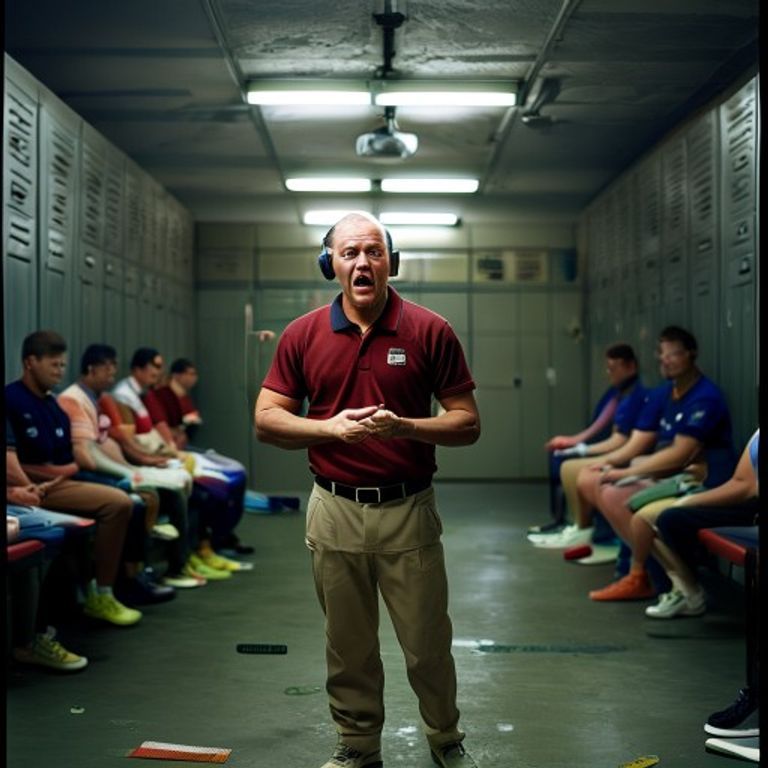
The prompt
Re-render this image as a documentary-style photograph in the register of an American football or basketball locker-room interior at halftime, mid-game, indoor evening lighting. Setting: institutional locker-room interior with metal or wooden lockers lining the walls (no legible names, no legible numerals on lockers), benches running parallel to lockers, concrete or tile floor visible with scattered tape-strips, towels, and equipment-bags, ceiling-mounted fluorescent strip-lighting providing the characteristic flat-bright locker-room illumination with slight greenish-cool color cast. Subject (the coach) positioned standing at the center of the room or at the front of the room with players seated on the surrounding benches forming an audience-arc, body squared toward the room, one hand emphatically pointed or palm-down for emphasis, the other hand at side or holding a small clipboard or rolled-up play-sheet. Face captured at the peak of mid-address: jaw set, eyes locked on the room, mouth open in active speech, neck-veins faintly visible, the expression of a person delivering a sovereign-decision speech rather than tactical-coaching instruction. Coach attire: a coaching-staff polo or quarter-zip in team-colors with the sleeves slightly rolled (no legible team-name, no logo), khaki coaching-pants, the headset still hanging around the neck, a small game-script card visible folded in the breast pocket. Visible in the surrounding mid-and-near-ground: players seated on benches still in full uniform (jerseys, pads, partial-equipment with helmets resting on the floor or on the bench beside them), bodies forward-leaning with elbows on knees or hands clasped in front, faces tilted up toward the coach in held-attention, sweat-sheen on skin, a few towels around shoulders, one or two players with bowed heads listening. Air slightly hazy with the visible warm-breath and locker-room-humidity haze. Lighting: even fluorescent overhead as primary key, fill from secondary fixtures producing the honest-flat institutional lighting, the coach is illuminated the same as the players (no heroic spotlight), the visual hierarchy is from posture and gaze-convergence not from lighting. Rendering: documentary photo realism, slightly cool color temperature, mid-grain film texture, sharp focus on the coach with players in slightly softer mid-ground focus (the gaze-direction of the players draws the eye toward the coach), no motion blur. Color palette: institutional locker-grey or wood-tan dominant, team-color polo on the coach as the warm-accent, naturalistic skin tones, no color treatment. Mood: the sovereign-moment register where halftime is not a tactical-adjustment meeting but a decision-to-fight-the-second-half deliberation, the Schmitt-friend-enemy distinction articulated by a single authority who names the second-half as the test that the first-half was the rehearsal for, the room held in the stillness that only happens when a group is about to commit to a decision it cannot take back. Composition leaves the upper or behind-the-coach background area open for caption insertion. No legible text on lockers, jerseys, or apparel, no real numerals on jersey backs, no team-name visible, no logo, no watermark. Aspect ratio matching source. Preserve the subject, pose, and composition of the source image exactly, change only the medium and rendering.
What it is doing
The halftime locker-room address is the closest thing American sports has to a sovereign-decision moment in the Schmitt sense. The first half is a known result. The second half has not happened yet. The coach in the center of the locker room is not running through X's and O's, that work was done before the game; the coach is articulating the decision to fight the second half as a single bounded act that the room is about to commit to or not. The register encodes the Schmitt friend-enemy distinction in its purest non-political form: the second-half opponent is named as the enemy, the group is named as the friend, and the coach's authority is the act of naming. Players who walk back onto the field after the address have signed the sovereign commitment whether they intended to or not. Applied to any subject in a pre-second-half address posture (board meetings before pivotal quarters, military pre-operations briefings, political-campaign pre-debate huddles), the frame asserts that the address IS the decision and the X's-and-O's are downstream.
Ways to change it
Pick any of these in the gallery and the choice is added to the prompt you copy.
- Coach intensity: jaw set, mouth open mid-sentence, neck veins faint, eyes locked on room (signature) vs full shout, mouth wide, neck veins bulging, finger jabbing at players vs leaning in low, lips barely parted, narrowed eyes, body utterly still
- Player-posture dial: forward-leaning elbows-on-knees, locked attention (signature) vs seated-back against lockers, half-broken posture (losing-team-context) vs standing in a tight circle around coach (compressed-intimacy variant)
- Sport dial: American football locker room with pads and helmets (signature) vs basketball locker room with warm-ups and jerseys (compressed-roster) vs hockey locker room with skates and shoulder-pads (cold-weather variant)
- Halftime mood: players slumped and heads down, coach pleading, towels over shoulders (signature) vs players loose and smiling, coach scowling with a warning finger raised vs players leaning forward on bench edges, coach mid-shout with fist clenched
- Lighting dial: flat fluorescent overhead (signature honest) vs single hanging-lamp dramatic (cinematic-stylized) vs mixed fluorescent + window-light from above-floor window (atmospheric-grit)
Related prompts
See all 18 prompts in the Coach grammar