Coach / Style prompt
Coach Wrestling Room Mat Drilling Grind
A wrestling coach standing arms-crossed on the edge of a worn red practice mat, watching a partner-drill grind under fluorescent gym lights. The mat-room cadre register.
Customize this prompt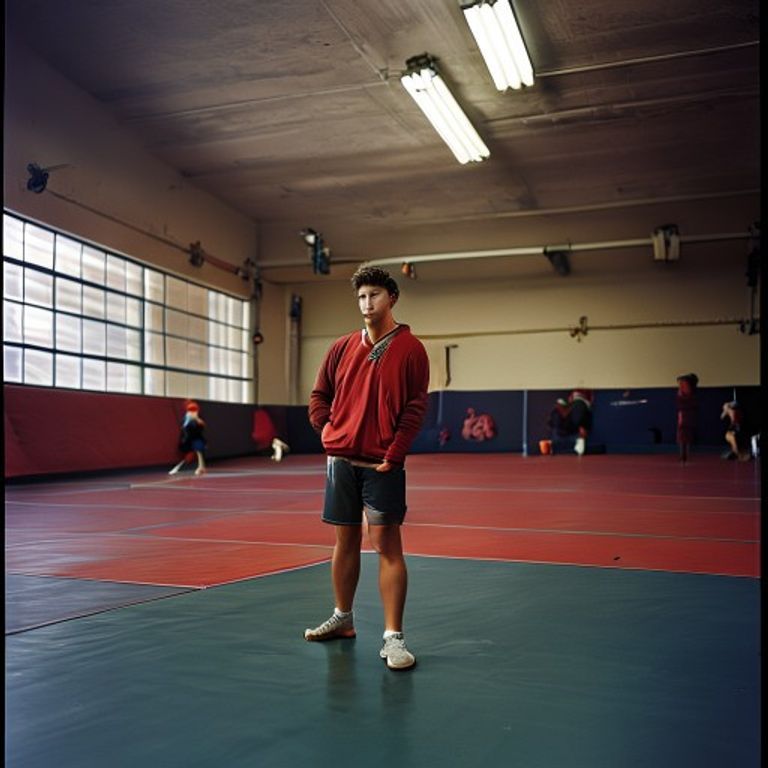
The prompt
Re-render this image as a documentary-style photograph in the register of a 1990s American high-school or small-college wrestling-room interior during a winter-season afternoon practice. Setting: dedicated wrestling practice-room with wall-to-wall padded mat surface in the canonical worn-red or worn-blue color, walls padded to about chest height in the same mat-color with wrestling-circle markings painted on the mat (no legible school name, no legible numerals, only the geometric circle markings). Wall padding shows visible wear-marks (scuffs, faded patches) from years of bodies pressed against it. Fluorescent overhead lighting from ceiling-mounted strip fixtures producing the characteristic flat-bright gym lighting with slight greenish-cool color cast and faint long shadows directly under feet. Subject (the coach) positioned standing at the edge of the mat or at the corner where mat meets wall, arms folded across chest or hands on hips, weight on one foot, watching the practice intently with a flat unreadable expression. Coach attire: a faded school-color hooded sweatshirt or athletic-cut quarter-zip pullover with the sleeves pushed up, athletic shorts or sweatpants, well-worn wrestling shoes or simple athletic shoes, a stopwatch on a lanyard around the neck or held in one hand, a single rolled towel over one shoulder. Visible in the background mid-and-far-ground: pairs of wrestlers on the mat working a drilling sequence (one partner shooting a takedown, the other absorbing and turning), bodies positioned low to the mat, the suggestion of repetitive grind not match-intensity but practice-intensity, sweat-sheen on skin under the fluorescent light. Air slightly hazy with the visible warm exhalation breath in the gym-cooled room and the subtle particle-suspension of mat-rubber dust. Lighting: even fluorescent overhead key, no dramatic chiaroscuro, the lighting is honest-flat-gymnasium light, not heroic. Rendering: documentary photo realism, slightly cool color temperature, mid-grain film texture, sharp focus on the coach with the partner-drilling in slightly softer mid-ground focus, no motion blur on the coach (the coach is the still center, the action is around them). Color palette: red-mat or blue-mat dominant in the foreground, the school-color sweatshirt as secondary, cool fluorescent ambient overall, naturalistic skin tones biased slightly cool, no color treatment. Mood: the cadre register where the coach is the standing-still cadre of discipline that the room organizes itself around, the mat-room converts effort directly into character through repetition under watching, the Wingate-special-operations training-by-attrition mode where the room itself does the work and the coach is the cadre presence that prevents the room from softening. Composition leaves the upper or lower margin open for caption insertion. No legible text on walls or apparel, no real numerals on the mat-circle or scoreboard, no school-name visible, no logo, no watermark. Aspect ratio matching source. Preserve the subject, pose, and composition of the source image exactly, change only the medium and rendering.
What it is doing
The wrestling room is the most efficient character-manufacturing facility in American secondary education. The practice format is brutal in a specific way: there is no ball, no opponent-team to blame, no defensive scheme to hide inside. The drill is two bodies, one mat, and repetition under a cadre's watch. The coach standing at the edge of the mat with arms folded is not coaching technique in that moment; the coach is providing the cadre-presence that keeps the room from softening into half-effort. The register encodes the Wingate special-operations cadre-by-attrition mode applied to youth athletics: the mat room converts effort directly into character because there is nowhere for effort to leak out into team-credit or position-specialization. Applied to any subject in a cadre-watching-the-grind posture, the frame asserts that the standing-still cadre is the load-bearing variable, not the technique-instruction.
Ways to change it
Pick any of these in the gallery and the choice is added to the prompt you copy.
- Coach-posture dial: arms-folded watching (signature cadre-distance) vs hands-on-hips engaged (closer-watching) vs kneeling at mat-edge giving correction (active-coaching, less cadre)
- Background-activity dial: partner-drilling sequence (signature practice) vs live-go scrimmage (peak-intensity) vs conditioning-circles running (off-mat-work, austere)
- Lighting dial: flat fluorescent overhead (signature honest-gym) vs single overhead spotlight, dramatic (heroic, false) vs winter-afternoon window-light from high gym windows (soft, atmospheric)
- Era: 1990s worn red mats, padded walls, greenish fluorescent strip lights (signature) vs 1970s bare cinder-block walls, thin faded mats, harsh bulbs, grainy film vs 2020s spotless new mats, LED panels, glossy wall graphics, crisp digital look
- Coach attire: faded school-color hoodie, sleeves pushed up, well-worn (signature) vs navy coaching-staff polo tucked into khaki slacks vs wrestling singlet under an open nylon warm-up jacket
Related prompts
See all 18 prompts in the Coach grammar