Handscroll Vertical Architecture (Style-Only, Image-Conditioned)
Style register: Chinese architectural handscroll viewing, successive ink planes and ruled-line structural detail emphasizing the vertical rise of existing built forms.
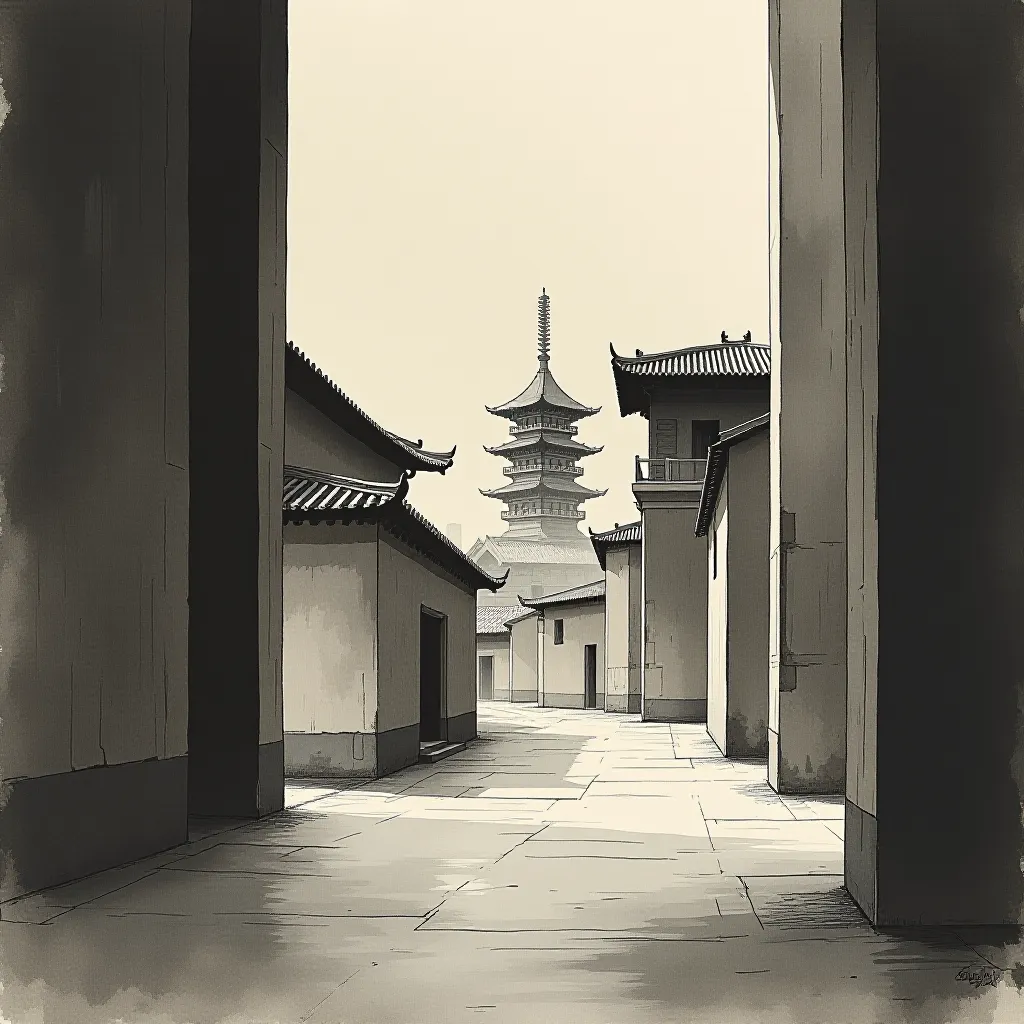
The prompt
Re-render this image as an architectural passage in a Chinese ink handscroll, with a measured eye movement through successive vertical planes. Keep the source aspect ratio, subject, and composition exactly; the scroll is a viewing grammar, not a command to extend the canvas sideways. Give any existing upright forms a clear visual ascent by varying ink density from base to top, while preserving their actual height and location. Use a ruler-guided fine brush for straight structural edges and a freer dry brush for stone, timber grain, plaster, or the nearest equivalent material already in the source. Layer translucent gray washes between foreground and background planes so the eye discovers depth step by step. Work in soot black, quiet warm gray, and aged ivory paper, with a little diluted tea wash where surfaces recede. If the image has no buildings, apply the same ruled-line rhythm to its existing planar objects rather than inserting architecture. Slight joins, interrupted edges, and absorbent xuan fibers should show a hand coordinating precision with breath. Keep broad structural silhouettes strong enough to read at thumbnail size; save hairline details for a closer look. The mood is deliberate and sequential, never a flat blueprint or a decorative panorama. Leave a calm, uncluttered band of negative space along the top or bottom edge where a title could sit. Strictly no on-canvas text, no legible lettering, no signature, no watermark, no logos. Preserve the subject, pose, and composition of the source image exactly, change only the medium and rendering. Aspect ratio matches source.
What it is doing
A building is never grasped in one instant: the viewer follows its edge, meets an interruption, and resumes. Scroll logic makes the duration of that encounter visible without redrawing the place.
Tuning knobs
- Line: `ruled structure with dry texture` (signature) vs `mostly ruled contour` vs `freer broken edges`
- Ascent: `dark base to lighter top` (signature) vs `even ink density` vs `dark upper anchor`
- Depth: `successive translucent planes` (signature) vs `two crisp planes` vs `single shallow plane`
- Surface: `fibrous aged ivory` (signature) vs `smooth cream` vs `light tea stain`
Related prompts
See all 10 prompts in the Chinese-Ink-Wash grammar · Open in the gallery
Get the free sample. The intro plus the first three chapters of The Liberation Engine, delivered as a PDF. The full book and the complete 606-prompt method are the paid edition.