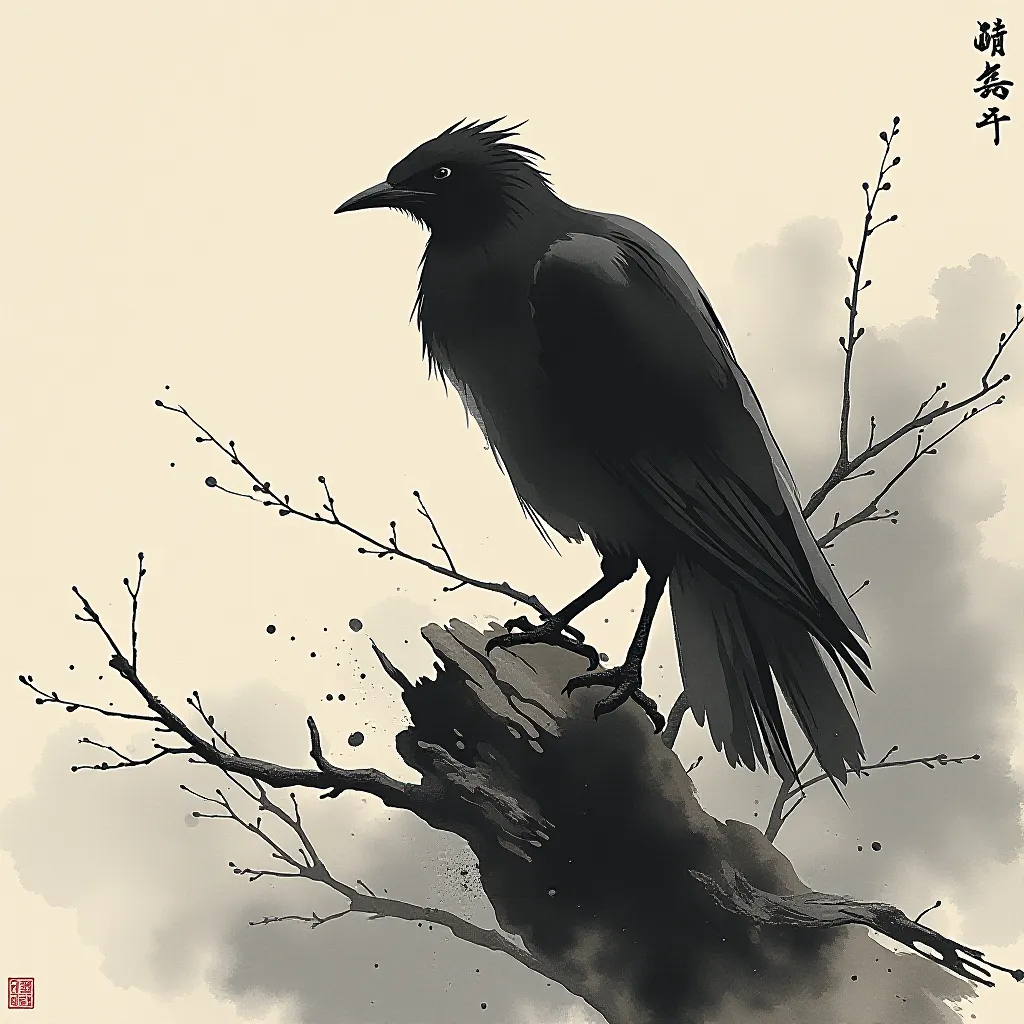
Xu Wei Splashed Ink (Style-Only, Image-Conditioned)
Style register: Xu Wei's Ming-dynasty xieyi freehand, splashed ink and abrupt dry-brush accents held in tension with recognizable forms.
The prompt
Re-render this image as a Ming-dynasty xieyi freehand ink painting in the expressive register of Xu Wei. Retain the subject's exact placement and silhouette; let the wash behave unpredictably only inside and around its existing shapes. Splash diluted soot ink onto absorbent xuan paper so soft-edged blooms pool into near-black islands, then scrape a nearly dry brush through the wet field to expose pale paper fiber. A fast wrist turn should leave tapered, irregular contours, not evenly weighted outlines. Reserve a few deliberate dark accents at the subject's most recognizable joints or edges so the image reads instantly at thumbnail scale. Use only deep lampblack, blue-gray dilution, and the natural ivory of the sheet. Surface accidents matter: feathering where water outruns pigment, backruns where a wetter drop meets drying ink, and a fleck of exposed paper in every dense passage. Do not scatter decorative splashes into empty space for their own sake. The energy should feel improvised but the arrangement must still follow the source, including any portrait, object, architecture, or plant already visible. Contrast flooded and nearly dry marks to distinguish form from atmosphere without inventing a new scene. Leave a calm, uncluttered band of negative space along the top or bottom edge where a title could sit. Strictly no on-canvas text, no legible lettering, no signature, no watermark, no logos. Preserve the subject, pose, and composition of the source image exactly, change only the medium and rendering. Aspect ratio matches source.
What it is doing
A splash is not randomness displayed as skill. It is a wager that a recognizably precise subject can remain present even when the tool refuses complete control.
Tuning knobs
- Water load: `wet blooms against dry scrape` (signature) vs `mostly dry brush` vs `even diluted wash`
- Accent: `few dark structural anchors` (signature) vs `continuous outline` vs `almost no anchors`
- Edge: `feathered pool beside sharp stroke` (signature) vs `uniformly soft` vs `uniformly hard`
- Pace: `abrupt wrist turns` (signature) vs `slow sweeping strokes` vs `small careful marks`
Related prompts
See all 10 prompts in the Chinese-Ink-Wash grammar · Open in the gallery
Get the free sample. The intro plus the first three chapters of The Liberation Engine, delivered as a PDF. The full book and the complete 606-prompt method are the paid edition.