Cartoon / Style prompt
Fleischer 1930s Rubberhose Rotoscope (Style-Only, Image-Conditioned)
Style register: Fleischer Studios 1930 through 1934 grammar, Betty Boop and Popeye and the Color Classics, rubberhose limb animation, rotoscoped jazz performers in the bandstand, urban surrealism with sexual and racial subtext intact, pre-Hays-Code chaos.
Customize this prompt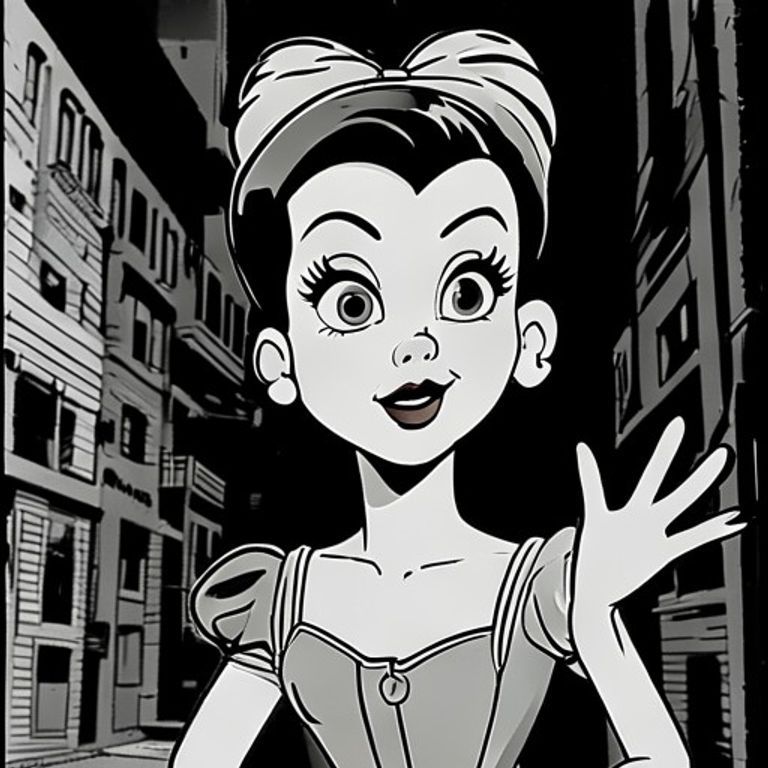
The prompt
Re-render this image as a Fleischer Studios cel-animated frame from the pre-Hays-Code era, between 1930 and 1934, in the visual register of Betty Boop in Snow White (1933), Minnie the Moocher (1932), and the early Popeye shorts. Black-and-white silver-gelatin film aesthetic: high-contrast monochrome, dense blacks, bright whites, narrow tonal mid-range, the look of nitrate film stock projected through a tungsten bulb. Character animation: RUBBERHOSE limb construction (arms and legs as flexible noodles with no visible joints, ends in white-glove hands and round-bulb shoes), bouncy elastic motion, the body squashing and stretching at every step. Bold confident ink contour line of uniform weight, characters built on geometric primitives (circle head, oval body, sausage limbs). Background painted in deep grey gouache with heavy black shadow areas, urban environments rendered as Art Deco fever-dreams: skewed alleyways, melting tenement buildings, anthropomorphic furniture, the kitchen sink with eyes, the building leaning in to listen. Optional sequences: rotoscoped jazz performer (Cab Calloway, Louis Armstrong) traced over with eerie photographic accuracy in the middle of an otherwise cartoon scene, the realism uncanny. Mood: woozy, sexually charged, surreal, the cartoon pre-Code permission to be weird and adult, the city as an inebriated organism. Slight 35mm film grain, faint nitrate flicker, occasional scratch and dust artifact. 4:3 academy aspect ratio. No on-canvas text, no studio mark, no song-lyric subtitle, no English lettering hallucinated onto the frame. Preserve the subject, pose, and composition of the source image exactly, change only the medium and rendering.
What it is doing
The Fleischers ran a New York studio in direct opposition to Disney's California one. Disney was clean, family-friendly, vertically integrated, racist in the polite way. Fleischer was urban, Jewish, jazz-aligned, sexually frank, surrealist, and racist in the Cab-Calloway-on-screen way. The 1934 Hays Code killed the rubberhose register: Betty Boop's skirt got longer, her garter went away, the moocher got cleaned up. The Fleischer aesthetic is the documentary of what American animation was BEFORE censorship made it polite.
Ways to change it
Pick any of these in the gallery and the choice is added to the prompt you copy.
- Era flavor: 1932 surreal peak, melting buildings, leering furniture, everything alive and wobbling (signature) vs 1933 rotoscope peak, one photo-real traced dancer amid rubbery cartoon chaos vs 1934 post-Code tidiness, cleaner sets, calmer poses, cuter rounder characters
- Limb construction: pure rubberhose, no joints (signature) vs subtle joint suggestion vs more anatomical (un-Fleischer)
- Background register: melting Art Deco urban surreal (signature) vs domestic interior surreal vs cleaner geometric Deco
- Rotoscope inclusion: eerie photographic-accurate performer in mid-scene (signature for Calloway shorts) vs pure cartoon, no rotoscope
- Film stock: nitrate B&W with flicker and scratch (signature) vs early two-strip Technicolor (Color Classics register)
- Scene mood: melting, leaning buildings and swaying furniture in a tipsy, dreamlike haze (signature) vs upright, steady sets with clear pratfall action, flying hats and bonk stars vs pitch-black cave with long shadows and translucent ghosts drifting through
Style lineage
Learn the visual culture this draws from: Britannica.
Related prompts
See all 7 prompts in the Cartoon grammar