Tartakovsky Samurai Jack Negative Space (Style-Only, Image-Conditioned)
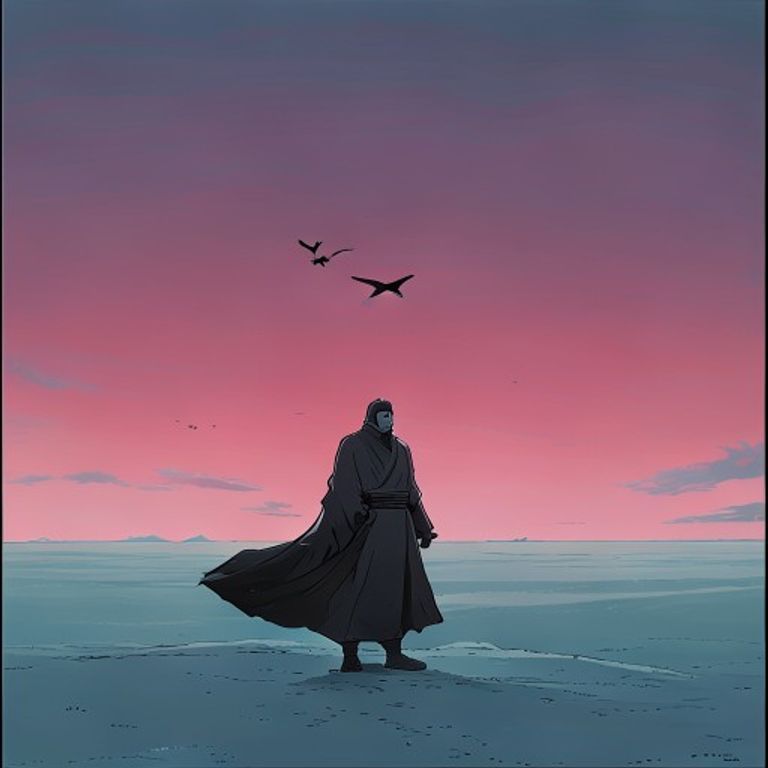
Style register: Genndy Tartakovsky 2001 through 2004 grammar, Samurai Jack and Star Wars Clone Wars, cinematic widescreen composition, massive negative space, the figure isolated against vast environment, action staged as still-frame tableau.
The prompt
Re-render this image as a frame from a Genndy Tartakovsky animated series in the visual register of Samurai Jack (2001-2004) and Star Wars Clone Wars (2003-2005). Cinematic widescreen aspect ratio (2.35:1 or 16:9), composition staged as a single decisive frame rather than a continuous motion. Figure rendered with SHARP CLEAN GEOMETRIC SHAPE LANGUAGE, no outline, color blocks meeting directly at hard edges, the silhouette acting as the entire character description, the body composed of confident large simple shapes that read instantly at any size. Color: flat fills with NO gradient modeling, but ONE bold shadow plane added per figure as a flat secondary color, giving a two-tone graphic-poster look. Background: extreme negative space, 70-90% of the frame is a single flat sky or ground color (a vast pale-pink dusk sky, a featureless cold-grey snow plain, an endless deep-cyan ocean), with the figure pushed to a precise rule-of-thirds intersection, the environment doing all the emotional work. Tiny graphic-design details placed sparingly across the empty plane: a single distant tree silhouette, a flock of three birds, a single mountain shape on the horizon. Lighting: dramatic single-source side-light suggested through the shadow plane, never naturalistic, always graphic. Texture: subtle airbrushed atmospheric gradient in the sky (the only modeling allowed), faint film grain over the entire frame. Mood: contemplative, patient, the moment BEFORE the action rather than the action itself, the frame holding for an extra beat. No on-canvas text, no logos, no studio mark, no hallucinated Japanese kanji or hiragana. Preserve the subject, pose, and composition of the source image exactly, change only the medium and rendering.
What it is doing
Tartakovsky's Samurai Jack stripped Western broadcast cartoon back to the bone and rebuilt it on Kurosawa, Kubrick, and Eyvind Earle. The negative-space frame is a moral assertion: the cartoon does not need to fill every pixel to earn its budget, the empty plane IS the cinematography. The patient still-frame tableau refuses the hyperactive cut-rate motion of contemporary kids' television. It is animation that takes itself seriously enough to hold a single image for five seconds.
Tuning knobs
- Negative space ratio: `80% empty plane, figure on third` (signature) vs `60% (more populated)` vs `95% (extreme)`
- Background flat color: `pale-pink dusk` vs `cold-grey snow plain` (signature) vs `deep-cyan ocean` vs `warm ochre desert`
- Shadow plane treatment: `single flat secondary color, hard edge` (signature) vs `no shadow plane (purer flat)` vs `multiple stepped shadow planes`
- Compositional incident: `single distant element (tree / flock / mountain)` (signature) vs `pure empty plane` vs `multiple sparse incidents`
- Aspect ratio: `2.35:1 cinematic widescreen` (signature) vs `16:9 broadcast`
- Era: `2001 Samurai Jack pilot register` vs `2004 Clone Wars expanded` (signature) vs `2017 Samurai Jack revival darker`
Style lineage
Learn the visual culture this draws from: Animation Obsessive.
Related prompts
See all 7 prompts in the Cartoon grammar · Open in the gallery