Gaudi Trencadis Mosaic Surface (Style-Only, Image-Conditioned)
Style register: Antoni Gaudi's trencadis ceramic surfaces, broken glazed tile set into flowing masonry, light in grout lines, and structural curves built from fragments.
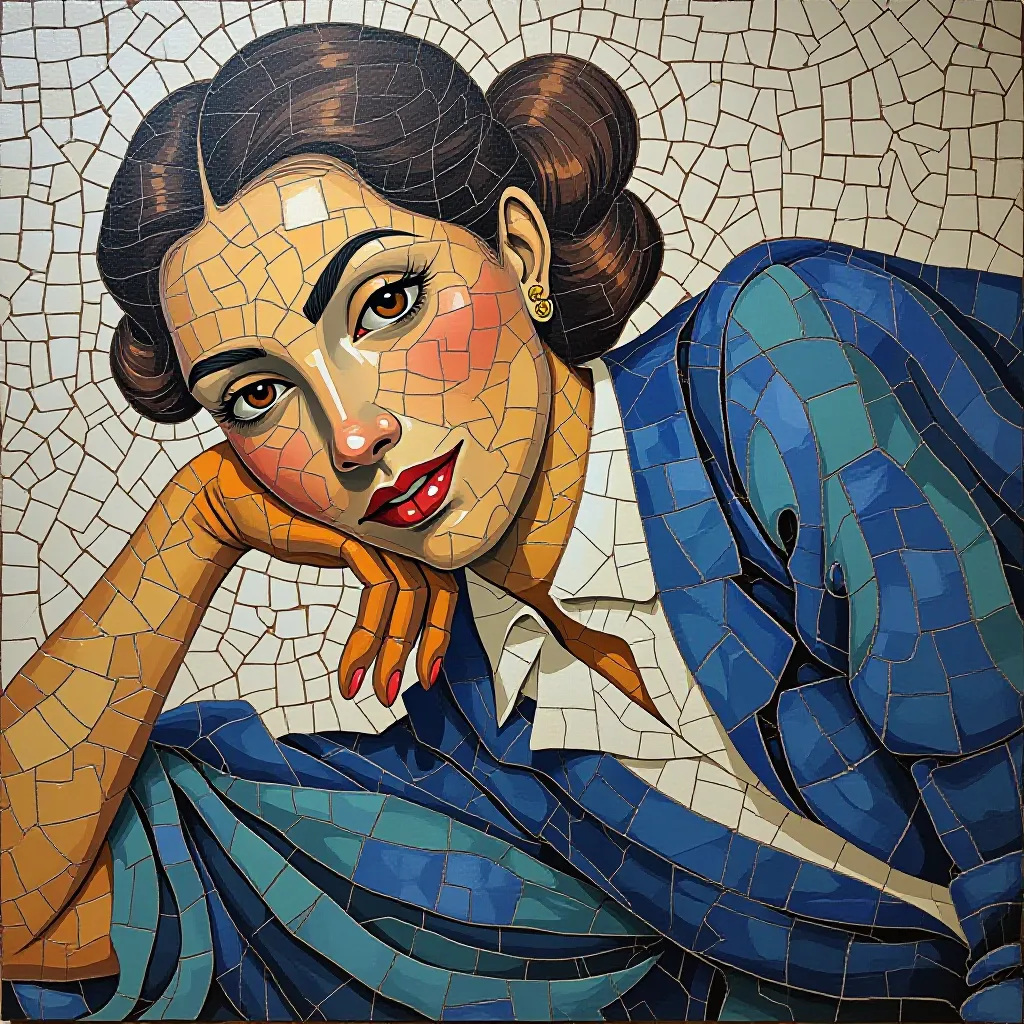
The prompt
Re-render this image as an Antoni Gaudi-inspired trencadis mosaic surface from Barcelona around 1905. Preserve the exact subject, pose, and arrangement, but rebuild each broad color region from irregular pieces of broken glazed ceramic pressed into gently undulating plaster. Keep the most important contour readable by aligning a row of dark blue fragments along it; use slightly larger pieces for open planes and smaller shards only where a curve turns tightly. Work in cobalt, sea green, creamy white, terracotta, and small sun-yellow accents. Separate pieces with visible pale grout of uneven width; allow a few chipped glaze edges and subtle differences in tile thickness to catch the light. Let long, flowing bands of tile follow the source's existing directional lines rather than inventing a new architecture around it. Reserve a broad, quiet plaster field where the original image has breathing room, so the pattern never buries the focal subject. The surface should feel touchable and built, with shallow cast shadows and a few glossy reflections, not like a flat digital pixel grid. At thumbnail size, strong color masses should cohere before individual pieces become visible. The mood is joyous and materially grounded: damaged fragments forming a continuous image. Leave a calm, uncluttered band of negative space along the top or bottom edge where a title could sit. Strictly no on-canvas text, no legible lettering, no signature, no watermark, no logos. Preserve the subject, pose, and composition of the source image exactly, change only the medium and rendering. Aspect ratio matches source.
What it is doing
Trencadis makes continuity out of broken things without hiding the breaks. Each grout line remains visible; the picture holds together because the fragments cooperate, not because they pretend to be whole again.
Tuning knobs
- Tile scale: `broad planes with tight curves` (signature) vs `uniform medium shards` vs `large rough fragments`
- Grout: `visible pale uneven lines` (signature) vs `narrow gray lines` vs `wide cream joints`
- Glaze: `varied gloss and chips` (signature) vs `mostly matte tile` vs `high-gloss ceramic`
- Directional band: `flow with source contours` (signature) vs `concentric arcs` vs `diagonal color sweeps`
Related prompts
See all 10 prompts in the Art-Nouveau grammar · Open in the gallery
Get the free sample. The intro plus the first three chapters of The Liberation Engine, delivered as a PDF. The full book and the complete 606-prompt method are the paid edition.