Tiffany Favrile Glass (Style-Only, Image-Conditioned)
Style register: Louis Comfort Tiffany's iridescent Favrile glass, molten color within translucent forms, wavy furnace marks, and light that appears to originate inside matter.
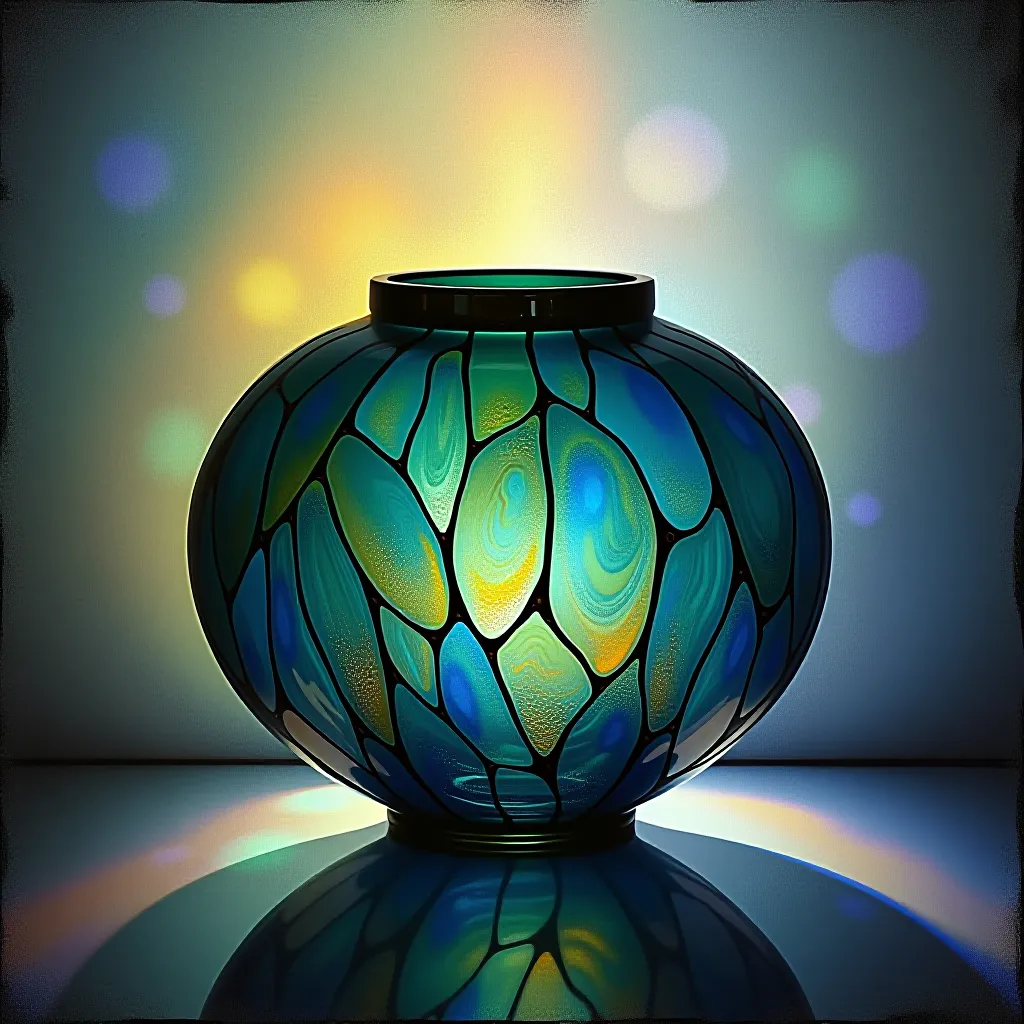
The prompt
Re-render this image as a luminous study in the Favrile glass register developed by Louis Comfort Tiffany around 1900. Translate the existing subject into thick, hand-blown glass forms without turning it into a different object or changing its pose. Give broad contours smooth hot-worked curves and make surface color seem suspended within the glass: peacock blue shifting to sea green, amber at the warm edges, and restrained violet where layers overlap. A thin metallic iridescence should roll across selected highlights, not blanket every plane. Show faint striations from the pull of molten glass, tiny trapped air bubbles, and uneven thickness where a rim or contour catches stronger light. Keep darker passages translucent enough to reveal interior depth; use a few opaque areas to separate the focal subject from the background. Behind it, add only soft concentric light and a spare arc of abstract petal-shaped reflections, not a new scene. Avoid lead outlines: this is furnace-formed glass rather than an assembled window. Let directional light pass through the subject onto the surrounding surface as broad tinted pools. At small scale, preserve the recognizable source silhouette and its strongest dark-light divisions. The mood is intimate, fluid, and slightly otherworldly. Leave a calm, uncluttered band of negative space along the top or bottom edge where a title could sit. Strictly no on-canvas text, no legible lettering, no signature, no watermark, no logos. Preserve the subject, pose, and composition of the source image exactly, change only the medium and rendering. Aspect ratio matches source.
What it is doing
Favrile refuses the idea that color is paint applied to a passive thing. Its shifting hues belong to the glass itself, and the viewer must change position before the surface gives up all its color.
Tuning knobs
- Iridescence: `selective metallic roll` (signature) vs `subtle pearl shimmer` vs `strong violet sheen`
- Glass depth: `visible interior color` (signature) vs `more opaque blown glass` vs `nearly transparent forms`
- Furnace trace: `fine pulled striations` (signature) vs `tiny air bubbles` vs `gentle swirl marks`
- Light: `broad tinted pools` (signature) vs `single rim highlight` vs `soft backlighting`
Related prompts
See all 10 prompts in the Art-Nouveau grammar · Open in the gallery
Get the free sample. The intro plus the first three chapters of The Liberation Engine, delivered as a PDF. The full book and the complete 606-prompt method are the paid edition.