Stepped Skyscraper Setback (Style-Only, Image-Conditioned)
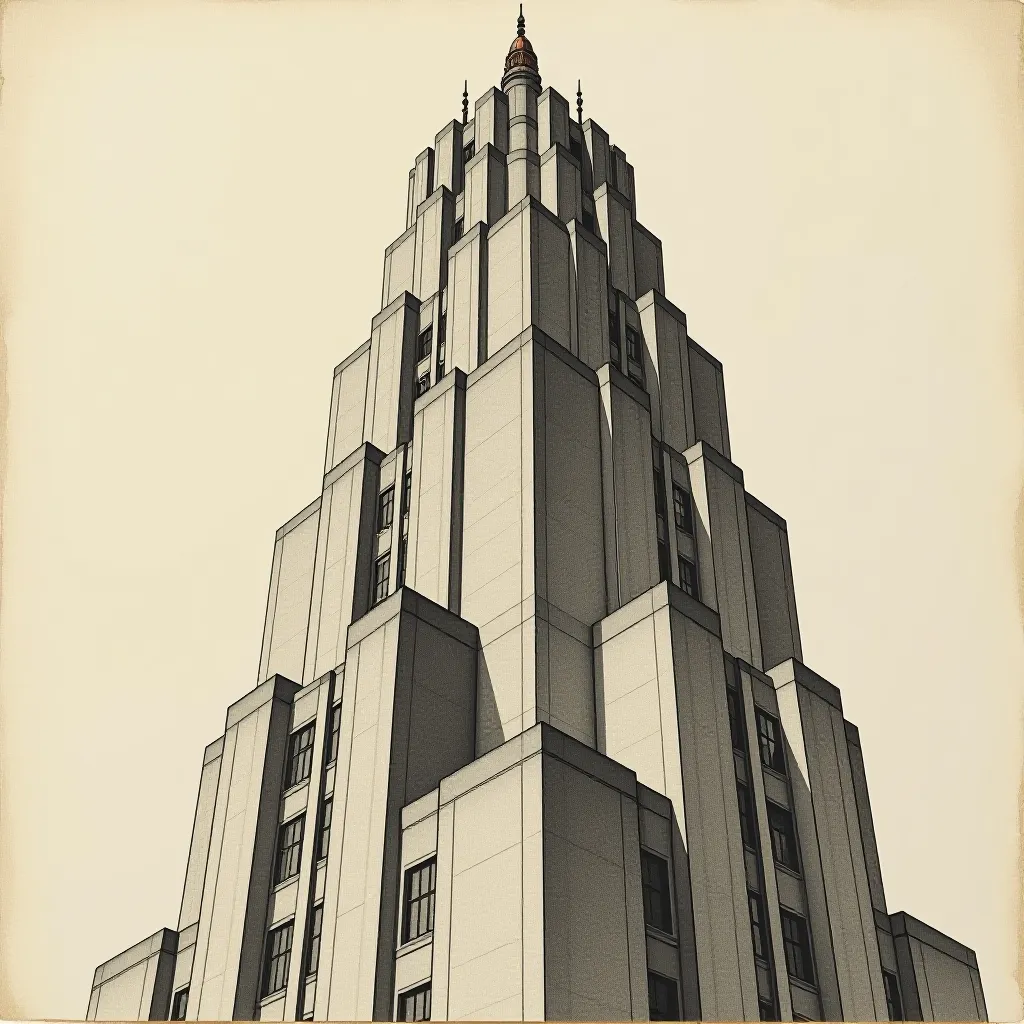
Style register: Manhattan 1920s setback towers rendered as an architect's tonal graphite and ink elevation, vertical ribs rising through nested terraces.
The prompt
Re-render this image as a 1930s architect's presentation drawing for a stepped Art Deco skyscraper, without turning the source subject into an actual building. Translate the subject's existing planes into terraced layers that grow narrower toward its highest visible point; preserve every recognizable contour and its place in the frame. Organize the background into a few ascending masonry-like masses and tall, narrow vertical ribs, recalling the New York setback towers of the late 1920s. Draft the main edges with a ruled graphite line and a crisp India ink contour. Lay translucent gray wash inside recessed planes, then draw long parallel pencil hatches down the shadow faces. Add sparse pale limestone highlights along the ridges and small glints of oxidized copper on the uppermost accents. Allow erasure ghosts, pinprick registration marks without symbols, and dry paper fiber to remain visible around the drawing. A deep ink shadow at the bottom should give the rising forms physical weight. Make the repetition broad enough to read at thumbnail size: three or four decisive terraces, not a swarm of windows. The atmosphere is upward-looking, hushed, and austere, with daylight sculpting structural depth rather than movie-premiere glamour. Leave a calm, uncluttered band of negative space along the top or bottom edge where a title could sit. Strictly no on-canvas text, no legible lettering, no signature, no watermark, no logos. Preserve the subject, pose, and composition of the source image exactly, change only the medium and rendering. Aspect ratio matches source.
What it is doing
The stepped tower made a legal building envelope feel like a spiritual ascent. Draftsmanship turns a constraint on mass into a public image of limitless growth. This register lets an ordinary outline inherit that ambition without pretending the object itself is architecture.
Tuning knobs
- Terraces: `three broad setbacks` (signature) vs `five tight setbacks` vs `two severe steps`
- Draft surface: `graphite on cream paper` (signature) vs `ink on vellum` vs `wash on gray paper`
- Shadow geometry: `long vertical hatching` (signature) vs `solid ink recesses` vs `soft graphite recesses`
- Light: `pale limestone daylight` (signature) vs `overcast silver` vs `warm low sun`
Related prompts
See all 10 prompts in the Art-Deco grammar · Open in the gallery
Get the free sample. The intro plus the first three chapters of The Liberation Engine, delivered as a PDF. The full book and the complete 606-prompt method are the paid edition.